Monday, October 14, 2013

Southwest France - visiting more Canal sites

Saturday morning, September 14 - - up early to try and photograph sunrise over the canal that faced our hotel.
Two small boats heading up the canal toward the larger harbour.
Then bags down by 8:15, breakfast, hop on the coach, and off to Narbonne.
Andre, our driver, works hard every morning loading the luggage.
It was a Roman town and had a Roman canal to link the town with the sea via the river Aude.  Eventually the river's course altered and abandoned the town.  In the 18th century a new canal (de la Junction) was built to connect Narbonne with the Canal du Midi, and an older canal (de la Robine) connecting Narbonne with the Mediterranean Sea was later linked with both La Junction and a portion of the Aude River, resulting in something called La Nouvelle Branch.  As we did not carefully inspect these waterways, we will take David's word for it (David being our guide/leader/friend David Edwards-May).
The weir is at the right, and the modern lock is to the left.
We had time in Narbonne for a walking tour.  Barbara and I opted to ride the local Navette (shuttle) to get oriented to the town, a ten minute round-trip, then we set off walking.
A handy shuttle bus, free of charge.
We saw the "Roman" weir next to a more modern lock,
This is the "modern" lock; to the right is the original channel that ended at the weir pictured two photos up.
walked to and then on the remnant of the Via Domitia (!)
Young children on an ancient road

Someday I will translate this message.
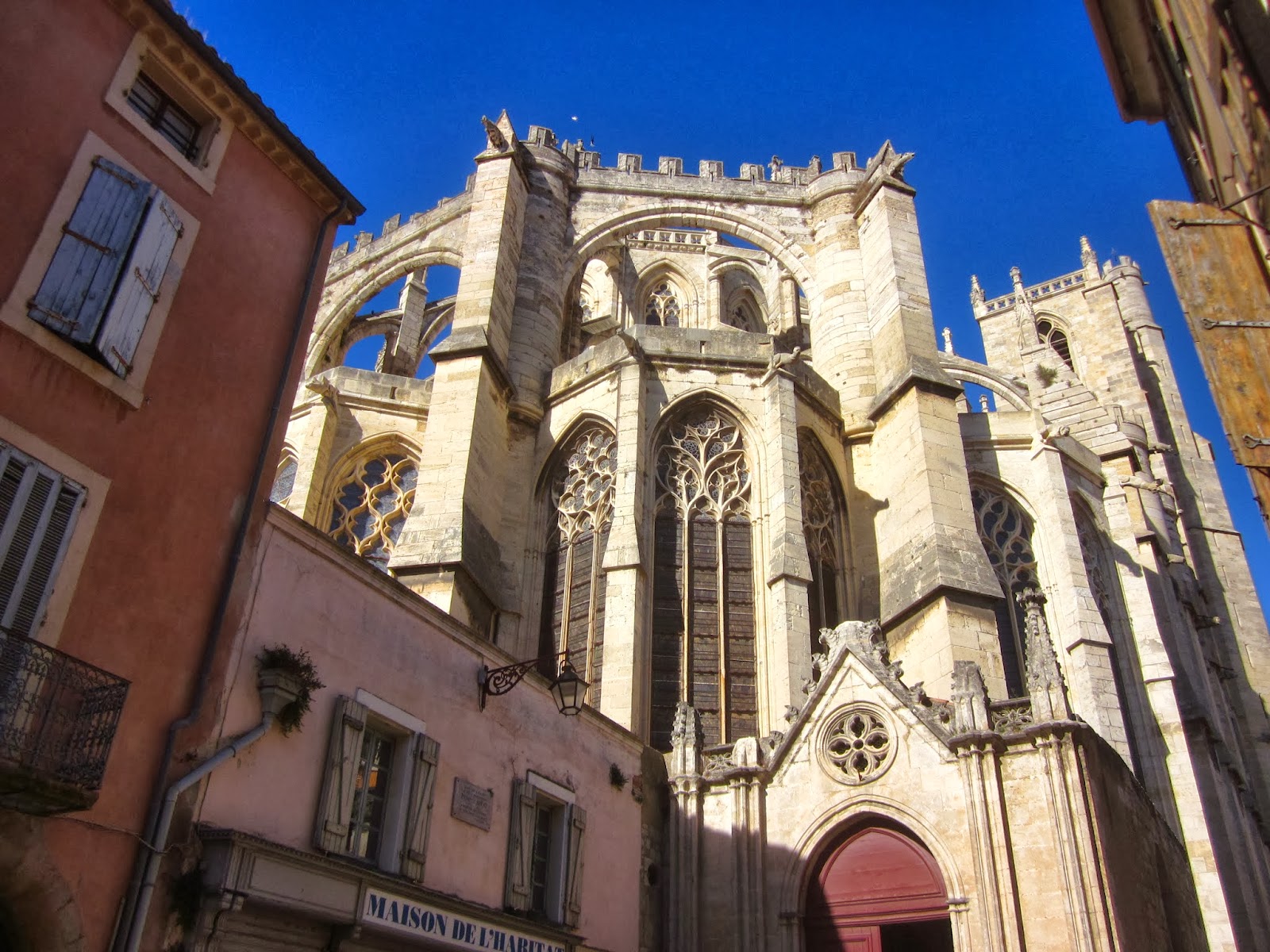
explored Narbonne's cathedral,
The cathedral is hemmed in on all sides by the city, no great plaza nearby.
which is missing about 4/5th of its transept and nave so that it looks half-abandoned.
The only entrance that was open was behind the fence

This is like viewing a ruin that's been kept in good repair.

We also saw and used a totally automatic and totally free toilette.
I had seen one of these years before in Paris. There was a fee, in francs (pre Euro days).
We drove to the canalside village of Le Somail for lunch at a restaurant, L'O a la Bouche.  This town was built as an overnight mooring on the Canal du Midi, and it's a nice, attractive place.
The little hump-back bridge is next to a small chapel built into the canal.
We ate outdoors under sunshading umbrellas.  Choice of lunch was a tagine of lamb and couscous or pork cheeks with potatoes. Anticipating that I may never again meet pork cheeks on the menu, I chose that, to my regret.  The first course and the dessert were quite nice, however.
An incredibly warm day, good food, and good friends.
Between courses, I got up and walked downstream a bit.  Many boats were moored on each side of the canal.  I saw a straight line of either large ducks or small geese swimming in a line across the water toward me.  Were they Mother and children?  or was it just follow the leader?
quack quack - did they think I would feed them?
We were to be driven to a village that was less than 1 km. from the Pont-Canal de Repudre, the aqueduct built by Riquet in 1676.  Unfortunately, the coach had to cross a bridge whose access meant a 90-degree right turn.  But the coach was too big.  Andre, the driver, had to carefully reverse back around the turn without damaging the bridge or the curbstones or the bridge railings OR the bus.  Sadly, one large door to the storage bed on the driver's side was badly bent.  They could not be unbent, but could be kept closed thanks to the bungee cords in Duncan's backpack.

The plan to drive us close to the Pont-canal was scrapped, and we would walk the mile or so down the towpath to see it.
Bill and Chris Holdsworth heading along the towpath.
It's important because it was designed and built directly under Riquet.  Other stream crossings were either culverted or were crossed at grade; these were changed to aqueducts sometime between 1680 and 1690.

One advantage of taking this walk was a very close-up view of the plane trees' damage. (My post for the previous day includes photos taken from the canal boat.) In some areas the trees might be totally dead and marked with three vertical blue dots, or clearly afflicted by the fungus or canker, and marked with a white X or healthy for now and marked with a green X.  There are said to be 42000 plane trees along the 240 km length of the Canal.  There is no known cure or treatment for the fungus, so as trees become infected they and their next several neighbors on each side are removed and burned on the spot.  In some places on this one-mile walk we passed stumps, dead trees, clearly infected trees, as well as beneath the welcome shade of fully-leafed trees.  The contrast was quite surprising; the prospect of a future without these beautiful and magnificent ancient trees is profoundly sad.

We headed along and came to the Riquet aqueduct across the Repudre (a little creek far below).  Many in our party climbed down the slope to get a good view (i.e., photo).
There is a plaque on this wall, commemorating Pierre-Paul Riquet, who built this structure in 1676.
I had forgotten about the long overflow on the far side of the aqueduct.  Three boats had preceeded us up the Canal and their wakes caused an overflow over this section.  Hence the wet paving stones rather than natural soil and grass typical of the towpath.
The paving stones, of course, prevented the towpath from being eroded by the wake of passing boats.
We were running late (something that became a recurring theme), so went directly to La Cite of Carcassonne.  This is a true medieval city, enclosed by a double rampart.  In the late 19th century, it was "restored" by Viollet-le-Duc, hence the heavy slate roofs on the towers, conical in shape.
This is a view from the hotel's terrace, inside the ramparts of La Cite.
We arrived late in the day when many day-trip visitors were leaving, so walking uphill against a flood of people was pretty slow.  Some of us went to walk through the Chateau Comtal and the ramparts. I chose to find my room and to relax.   The bags, somehow, were conveyed to the hotel, and to each room.  Hotel La Cite is very luxe and lovely; I think there was probably a staff person available for each guest everywhere.
The room is much larger than this photo shows.
My friends and I decided to dine at the cafe near the big well (L'Auberge du Grand Puits) where we'd dined in 2009.  Nothing seemed to have changed.  Same menu, same prices.  In 2009 I had "thon" (tuna), and it was again on the menu - - but not in the kitchen that evening.

Photos of L'Auberge du Grand Puits, Carcassonne
The well ("puit") is the large round structure to the left of the person in the striped shirt.
The Grand Puits before customers show up.
Word had come down from David Edwards-May for suitcases outside rooms by 7:15 am and ready to board the coach outside the Porte Narbonnaise by 8:15.  Hmm.  Could it be done?


Friday, October 11, 2013

Southwest France - visiting Canal du Midi sites

Friday, Sept. 13th, was a bright morning in Sete and we loaded ourselves onto the motor coach, setting off for Beziers to see the aqueduct over the Orb River, followed by the Orb lock.
The cathedral in Beziers sits high above everything.

On a boat called the Santa Maria we crossed the aqueduct and the lock
Very sturdy stone towpath


In mid-aqueduct on the Santa Maria

and there we beheld the Fonserannes staircase of locks.  Today there are six locks.  Originally there were eight, then the number was reduced to seven - -WHY?  In part, perhaps, for construction of the now-disused Incline Plane.
Too bad the details of the six locks are not legible.

The flight of locks is impressive, and they are exactly like those that we saw four years before - made of stone, with sides that were straight up and down but not straight from end to end. The sides curve, giving strength to the walls like an arch that lies on its side.
We're about to move from the canal into the lowest of the locks.

The single boat assistant handled all of the lines (it took two of us to handle the lines on our much smaller rented boat in 2009).
Not to be rushed, he texted frequently as the boat passed from lock to lock.  He did tie the boat off to a bollard, and he used the pole to push the bow away from lock gates and/or walls.

The captain described the lock operations as well as the ill-fated inclined plane.

That's not a giant mushroom.  It's a bollard.  Our boat was secured against the inrushing water.

Water was rushing down from the lock above, which is why the boat was secured to the bollard.

The boat captain  talked to us as we passed upward from lock to lock.  And in about half an hour, we were through and on our way along the Canal du Midi to the Malpas tunnel.
The most direct route for the canal had to go through the hill called Enserune. Riquet's team was a bit stumped by the brittle rock, and work was halted briefly. Although he was ordered to cease work, Riquet asked his team of masons to work in secret and managed to break through in 8 days.

So many photos must have been taken.  Many of us just sat back and enjoyed the short ride.

We went to it, through it, turned around and came back again.
Approaching the light at the end of the tunnel.

As we were cruising along, Barbara suddenly exclaimed "There's Ravel! That's our boat!"  Indeed, it was the same boat that in 2009 was our home for a week.  Nice to see that the old tub was still canalworthy. Sorry - no photos.

The large ancient plane trees that shade the Canal have been damaged by a fungus and must be removed. We saw areas where trees had been removed,
Not even stumps remain.

trees that have been marked as having the fungus,
And it was obvious even without the marks - the leaves were very few and were dying.

and trees that continue to provide shade and beauty to the waterway.
The shade also inhibits evaporation in summer's heat.

Lunch was served on the boat  - and a beauty of a lunch it was.  In the lounge, tables were set for four persons, who were served a fantastic casserole of yellow rice, peas, onion, other vegs., topped with four large shrimp, four pieces of chicken, and four mussels nestled in the rice.
Was this Laura, Kerry, Pat and Duncan?  Difficult to tell without a flash.

Not only beautiful but really delicious, too.  Our bowl had just a few grains of rice left at meals end.
Please note the variety of wines as well.

Back at the Fonserannes the boat was tied up and we all exited to go exploring for just a bit.  There was a deadline to meet the bus at the bottom of the flight but it was many minutes away so folks went exploring . . . or looking for ice cream.
Snack time beneath the shade.

Two of the curious New Yorkers tried to climb over (or under) the fence to examine to broken machine that was now stranded at the top of the Incline Plane.  I just wanted to get a look at it, so maybe I should have climbed under the fence too.

Eventually the strays were herded into the coach and off we went toward the Tunnel, but we drove up, up, and up to the top of the Enserune hill - winding and narrow- that was a good bus driver!.  So why were we there?  To look down on the Montady, a former lake, drained in the 1200s, with drainage canals radiating in toward the center - like bicycle spokes.
Done on the orders of the local biship in the 13th century.

The former lake was drained into a channel in the center where water was diverted away via an underground channel.  So they said. Seen from the greater height than we'd seen four years before, it was an impressive sight.

We had a long quiet ride back to Sete.  The next agenda item was dinner in our hotel at 20:00 hours.  So the rest of the day I napped, packed up for the next day, showered and dressed for dinner.

Dinner in the very nice restaurant was quite good, but again, with quite slow service.  The wait staff all looked to be busy, but perhaps there weren't enough to keep up.

Monday, October 7, 2013

Southwest France - a day in transit

Well, this morning (Wednesday) in Nimes, I was not feeling quite well - a sort of funny tummy.  It never led to anything alarming but was just uncomfortable.  Still I managed to getup and dressed - in normal clothes. No more hinking clothes - they were all bundled up and ready to go. Barb and I wanted to mail clothes home that we'd not want for the next two weeks. We were directed to La Poste, where for 39,85 Euros I could put together a large box and stuff the hiking clothes into it.  Even my hiking hat fit in. Only the trekking pole would not fit.  And except for that pole, I was rid of a bunch of stuff.  A slight feeling of freedom.

We strolled just a bit to a nearby statue of Augustus Caesar (I think)

surrounded by huge blocks of stone that may have been a memorial arch many centuries before.

But I still did not feel quite right, so I rested in the hotel lobby until the taxi came at 12:30 to take us to Nimes' train station..

At the train station, we tried to figure out how to buy tickets to the city of Sete from the big yellow SNCF machines, but hoped to find a live ticket seller. By great chance, our hostess from Collias, Marie-Agnes walked up to me, happy and surprised to see us there. We explained that we were having a bit of difficulty getting tickets. Marie-Agnes' daughter, Justine, was quite familiar with the machines. She stepped right up, asked a few questions, punched a few buttons, was delighted that we could each qualify for the "senior discount". But then the next barrier came with our credit cards and our debit cards. None of them had the required "chip" on the front.  So our clever hostess used her credit card, and we each gave her the cash.
I like French train travel. No matter what the train is, there are always clear instructions as to the track number or letter as well as where to await the train car. Every train seems to run on electricity, so they are fairly quiet as well.

We detrained at Sete ready to eat a bear. Fortunately there was a place where we could get sandwiches (why are they always made with baguettes?) and a cold soda - or beer. The train station is pretty far from where we were to spend the night - - like the opposite side of the city. But the hotel (called Joie des Sables) was right on the Mediterranean Sea, a place that we had been nearly panting to visit.

So we jumped into bathing suits and headed across to the water. The beach was protected by two breakwaters that curved around like protecting arms.

The water was a lot saltier than I'd expected, and a lot colder. I think I walked til the water was past my knees, but that was far enough for me. My friends were braver and went all the way in. The beach sand was very tan and fine, with tiny shell fragments scattered throughout. The wind blew strongly from the west, and I could feel it stinging my skin and getting between my teeth.

The hotel's restaurant was pretty nice, the service was slow, but the oysters (local, of course) were superb - out of this world. Way saltier than the local Virginia Chincoteagues.

Salmon was also superb. And the vanilla ice cream "Madagascar" was really very good. After rooming solo for several nights, I suggested that Barbara have a bit of solitude - she'd gone to some trouble to find this hotel for us. Pat and I got along fine and we read into the night. And so ended the day in transit, September 11.

And I must have read quite a lot, because the sun rose without me. Today we were to transfer to the Grand Hotel, the "official" pre-conference tour hotel for two nights. But checkout was not until 11:00 so we walked across the beach again, this time looking for shells. And there were many many to be found. Altogether a quiet and peaceful morning of beach-combing.
A treasure hunt.
We wandered over to one of the marinas there and met with a surprise. Two of the "water-jousting" boats were moored there. They are eight-oared boats with a long, wide but shallow ladder extending from the bow, with a platform at the end. According to postcard pictures, the "jouster" stands with his lance on the platform, the rowers race the boats toward each other, and the jouster attempts to "unhorse" the opponent.

Getting to the Grand Hotel involved a little adventuring - - to take the local bus, we walked down the street, around the round-about and up the hill to a bus shelter. The first bus was ours - it's destination was "GARE", the train station. However, the bus driver didn't quite understand my request for the "Hotel Grand". We were at the Gare when he turned back to me saying " Le Grand Hotel?"  I nodded yes, and he indicated that we wanted the third stop. And so it happened. There we were.
Sete is a small city on the Mediterranean Sea, criss-crossed with canals and waterways; lots of fishing boats, ferries, and pleasure boats as well.
The Grand Hotel is quite a piece of architecture - late 19th century styling, with a huge atrium in the center and most of the rooms off of very narrow walkways. Lucky me:  I don't like heights, so of course I was on the third floor, at the far end of the atrium from the elevator. The building was so old that the stone walkway to my room was worn in the center from over a century's worth of footsteps.
That walkway pictured upper right was way too narrow, but my suitcase did roll along nicely.
So around two in the afternoon (14:00 hours over there), our group of 32 or so climbed aboard the motor coach and drove off to Agen to see the round lock,
Some of us were amazed that this large boat fit into the lock.
then to the Libron crossing (which was a terribly confusing way for a canal to cross a river),
This boat has passed the complicated part.

despite explanations and diagrams, I don't understand.
and a quick look at the Orb aqueduct (I think).

From coach to open-topped boat for a trip across the Etang de Thau, which is a shallow lagoon, filled with oyster and mussel farms, and that particular afternoon it was covered with whitecaps.
Can I name everyone? last row = Keith and Judy Kroon, then the Chinese student, Padraic, Jilll and Cliveseveral unknowns, then Dan, Rod, Susan; a Brit whose name escapes me; Roger Squires; and right in front is Kerry Gruber.
First row = Dave Wahl and wife; Chris and Bill Holdsworth; Duncan Hay and Peter Anderson, with Carolla Grasso in the dark glasses
Indeed the water was choppy and in that open air boat we in the front got splashed - a lot. The point of going out there was to hear from the boat's driver a description of raising oysters (pretty complicated).
Little oysters ("spat") are first grown in these mesh thing that dangle from permanent structures in the lagoon.
These horizontal and vertical pieces constitute the oyster farm; growing and maturing oysters are suspended from the horizontals into the water.  At various stages they are checked, and about a year later they're harvested.
What's unique about the Thau oysters is that they are, from spat to finished, always in water. There is no tide in the lagoon, so the animal is never out of water. Is that why they are so salty?

Dinner was quite a few blocks away, at a place called "La Marina". I've forgotten the first course; the second was monkfish, which was fairly good but had a large chunk of what appeared to be spine! I won't ever forget the dessert - - a small chocolate baked thing with a large fiery "fountain" shooting out of it, along with a quite loud round of the Happy Birthday song for my 73rd birthday.
Fireworks for dessert?
That was my birthday candle.
Some time between the boat ride and the dinner, Barbara and I went to Monoprix to look for something to replace the white fleece jacket I'd lost on our very first day there.  I ended up with a brown cardigan sweater, fairly thin and light, but better than having nothing. A birthday present to me.