Sunday, October 9, 2011

World Canals Conference tours in Netherlands


Some Groningen rooftops as seen from our flat on Gelkingestraat

The World Canals Conference always has a dozen or more presentations on 3 or 4 different topics, held in the mornings, followed by field trips into the late aftternoon, and dinner in some interesting place.  The Netherlands Conference, held in the city of Groningen (photos above) was no different.  I'll concentrate on the places we went and things we saw rather than the papers read.  The field trips began Monday and ended Thursday.
We first visited the province of Drenthe, an agricultural area where peat had been dug for centuries, up until about 1970.  The peat canals have been restored for recreational boats, which also entails changing fixed bridges to swing or lift bridges.  And a new canal is being build to connect two towns - Erica and Ter Appel, near the border with Germany.  Part of it will have to be elevated around a forested area; to do that they are building a double lock at one end and a "water-saving" lock at the other (to pump water back to the double lock - they seem to think that makes sense).

Listening to public officials at a marina near Ter Appel
A view of one corner of the marina.

a tray of nibbles - - fruit and cheese

Here is one of the new bridges - a lift-bridge
Look at his feet! The ONLY time I saw wooden shoes!

Cruising along on the Veenparkcanaal in bright sunshine.


Veenpark was once a peat mining area.  My little engine hauled cars loaded with peat to the canal.  I think "Veen" is the same as "fen" in English.

Hard to see, but somewhere in there is the double lock under construction.


Near the very deep water-saving lock site, Rick Rivers ponders this huge granite glacial erratic, dug up at the construction site.


C & O Canal Assn. members:  Tom Lightfoot, Linda Lightfoot, Val Wheeler, Rachel Stewart, Laura Gilliam, John Wheeler, Pat White, and Barbara Sheridan - - dinner in the Veenpark restaurant.
We moved on to Friesland, to visit an aqueduct (the Geauakwadukt), and to see some interesting structures along the way.  And we were led by an intense woman who is the architect who designed the aqueduct.

A bridge made of wood?  or a wood veneer?

She is the architect who designed the Geauakwadukt, and I found her name thanks to the internet:  Tatjana Tzrin.
Yes, that boat is above the A7 motorway, through the Geauakwadukt on the Princesmargrietcanaal.  (I love the way a Dutch word translates into multiple English words.)

This is not a sculpture.  It is a beautiful structural wall beneath the aqueduct, separating the motorway lanes.

If you wonder who financed the aqueduct, enlarge this photo.
We moved on, toward an area that was one of the few natural "hills" in Friesland - a few meters above sea level.

High enough above sea level for a burial ground.
The town of Aduard was anchored by a Cistercian monastery until Catholics were proscribed.  This beautiful building, formerly the monastery's infirmary, is now a Protestant churc.

This brickwork is stunningly varied; the monastery was well known for brickmaking.
Across the road, we had an introduction to medieval brickmaking.

Meanwhile, in a neighboring yard, children played hide-and-seek.  In French, that would be cache-cache.  Wonder what it is in Dutch.

Finally, in the province of Groningen, we visited an absolutely enormous and major lock and went into the control room - really a three story tower - where men sat before many monitors showing not just one but several other large locks.

The enormous draw-bridge is going up, allowing the very long barge to pass.

In the control tower, with its many monitors and controllers.


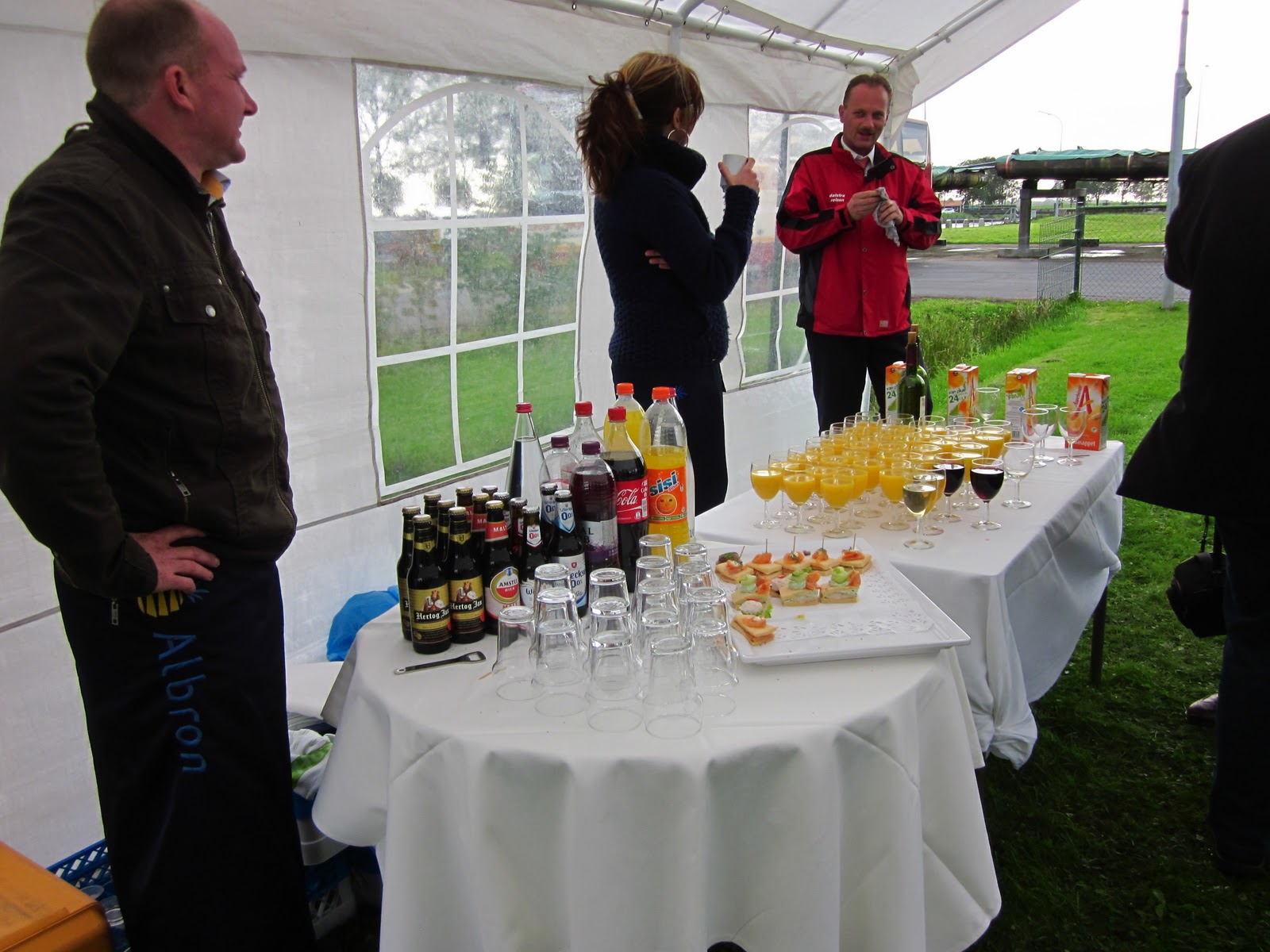
Next to the lock, some refreshments were provided.


On our return to Groningen, we walked to the yellow building, a large tavern-club where we had dinner.

Kathy and Laura looked away from the camera.

Yum!  Chocolate mousse topped with blueberries and chantilly.

Friday, October 7, 2011

Four Days on a Boat in Friesland


September 11 is the day we arrived . . . Pat, Barbara, Laura, and me.  Our first day/night in Netherlands was in Sneek (pronounced Snake), an old city in Friesland, whose "Waterpoort" is pictured above.  Like thousands of old European cities, there is a very compact center built around an old church, and the city center was nearly ringed by a canal.  In this city we were introduced to mustard soup (actually a thin soup with bacon and green onions flavored lightly with mustard).  We spent the night here because Woudsend, where we were to pick up the boat, has no hotel.  We taxied to Woudsend and found that our vessel, rented from LeBoat, was not ready.  So we wandered through Woudsend for a little while.  And we saw a working windmill, between houses on a quiet street.  It didn't appear to be milling anything - perhaps it was used to generate electricity?

Is that a windmilll in the middle of the town?

That windmill's blades were slowly turning, even without canvas sails unfurled.
LeBoat rentals are found all over western  Europe, and this marina was new, large, and spic-and-span.  Maybe the boat was not ready because it was the end of the season  - we never found out why we had to wait several hours.  When we finally went aboard for an introduction to operating the boat, the wind had developed to such an extent that it was very difficult to control the boat.

Patrick was our patient instructor, especially patient with my steering ability (or lack).
We decided to stay in the marina overnight and leave on Tuesday.  I was determined to master the art of steering so I took the boat out of the marina and down the canal . . . hadn't gone far when a very loud horn sounded - - a great green dredging barge was advancing on my rear.  So I spun the wheel to the right, ended up making a U-turn into the reeds, but avoided being run down. 

The flat green countryside supported farms as far as the horizon.  Reeds like these saved us from being overrun by the barge.
And eventually we cruised away from the town and into the very flat and very green countryside.  The wind continued to be troublesome, but we made it to our destination, Sneek.  Not so sure where to tie up, we did so at the first bollards we saw.  Quais in these towns are marked with "no parking" signs.  The best place to tie up is between the big red "P" where there are also electrical outlets.  We didn't know that, so we parked legally but spent the night using our battery. 

Our little boat was called "Tamaris", moored here in Sneek.

In the morning, the assistant harbourmaster came along to collect "rent" (based on the boat's length) and pointed out that just a short way down the quai we'd have electricity. 


The assistant harbormaster gave Pat a receipt for the "rent" and showed us where to moor with electricity..
 That day was very rainy and still windy so we elected to stay in the town and be sightseers.  Sneek has a great maritime museum; it's well organized, very new, and spreads into 5 or 6 buildings. 

 A very small fishing boat, typical, I'm told.
A child's sled/sleigh for winter's icy canals.

And also a miniature train museum in the former train station with very helpful volunteers.  Wonderful constructions of towns, farms, crossings, freight yards, complete with inch-tall figures.  One great construction had mountains - which Netherlands definitely lacks.  The volunteer guide said it was based on "those mountains in Switzerland" . . . "Alps?" we asked? 


The boat had two cabins, a galley, a lounge, two heads, and could be driven from inside or out. Outside was easier - because you have better sight lines.  Our meals were generally breakfast and lunch on the boat, dinner in town.   We'd stocked up on essential items (coffee, butter, cheese, bread, raisin buns, cereal, wine, beer, etc) while stuck in Woudsend.   Also wine and pastries for my birthday celebration.

birthday dessert.
Those weather-related delays meant that we had one last day for cruising, so off we went down through the town, under the lift-bridges, into a very wide channel with large dredging barges and some heavily laden barges, sailboats large and small, green & red channel markers, islands perfect for temporary mooring, and back to Woudsend.    Below are several photographs from that final day.

Waiting for the bridge tender to lift the bridge.

Passing through a fairly crowded town.

This sculpture marks the entrance to the newest aqueduct.


I wondered about the paddle-like things on the side of the boat - the boat's flatbottomed, so on windy days, they are lowered to provide leverage to the keel-less boat.

Pat at the helm.

Passing a dredger in an intersection of wide canals.

Sailboat with students passing us as we moored for lunch.

Our vessel, moored for lunch.  We were amused to see sails on the horizon with no evidence of a canal other than a green line of  reeds or trees.


Thursday, October 6, 2011

Netherlands, in three parts.

Recently I spent 18 days in the Netherlands.  The main reason for going there was the 24th (?) World Canals Conference, being held during the 3rd week of September in the city of Groningen.  The primary sponsors were three provinces:  Groningen, Friesland, and Drenthe.  These provinces are in the northeast of Netherlands.  Two of them border Germany:  Groningen and Drenthe.  And two of them border the North Sea:   Friesland and Groningen. 

With three friends from the C & O Canal Association, a boat was rented for a 4-5 day cruise on the canals and lakes of Friesland.  For the conference itself and a day or two before it, we rented two flats in the old center of Groningen for 6 of us.  And following the conference, the six of us rented an apartment in Amsterdam for another 4 days just to go sightseeing.  During the end of the conference I got sick, dragged myself through Amsterdam, which really was unexpectedly a very interesting place, and came home to spend lot of time in bed, sick, feverish, and coughing.  Now that I'm back (physically, mentally, and health-wise), I'm going to organize and select photos and post some stuff about the Netherlands trip.  Probably in three parts, one for each of the three parts of my visit.

So this post is sort of warming up to the idea. 

Wednesday, October 5, 2011

Why can't I do that?

I am an intelligent and capable person who turned 71 last month.  I've travelled to many varied and interesting places.  I have a college degree.  I married a good man and together we raised two brilliant children.  And we have no debt (mortgage, car loan, etc. - - none).  I went to law school in mid-life and became a lawyer.  I had a business for many years.  Now I'm president of a small non-profit, C & O Canal Association. 

So why, I ask, am I totally defeated by a tire gauge.  Yes, totally . . . nearly in tears of frustration.

And not just one tire gauge, but two.  This never happened with my former cars.  I'm going to blame it on the design of the wheel covers on this 2008 Honda Civic Hybrid car rather than personal ineptness.  Thank heaven for Marcos P. at Brown Arlington Honda, who inflated the tires for me.

Saturday, May 14, 2011

Appalachian Trail

A steep and rocky trail is hard on the knees, especially on the descent.
I've been hiking on the Appalachian Trail in Virginia with three friends - - not backpacking, just day-hiking.  We've done this several times now, and have covered the central section in Shenandoah National Park.

My hiking friends Barbara, Pat, and Linda.
Spring is slow to arrive on the mountains, so there were a lot of seldom-seen flowers along the trail. 
I'd never seen a yellow ladyslipper.

This is a white trillium.

Wild mountain azalea were everywhere.
We hiked around 23 miles; through-hikers do hundreds, up and down and up again over mountains, over rocks and roots.  It makes my knees ache to think about it. 

Scenic spot for lunch or just a rest.
About a dozen through-hikers who started on the trail in Georgia in March passed us over the 4 days.  We gave them homemade chocolate-chip cookies; through-hikers don't get treats very often.