Showing posts with label Friesland. Show all posts

Tuesday, October 18, 2011

Dutch towns.

Two Dutch towns:  Woudsend and Sneek.

A very large church - St. Martin's - with its unexplained wooden sidekick - in the center of Sneek.

Grand Cafe occupies a corner between the main road and the canal in Woudsend.
Netherlands towns were surprising to me.  From the village of Woudsend to the big city of Amsterdam, they were old-fashioned, even historic, but modern as well.  I certainly did not expect to see people in wooden shoes, women in white bonnets, men in blue balloon-leg pants, like some illustration from a child's storybook.  But I also did not expect to see everyone using cell phones, bike-riders not wearing helmets or spandex, absolutely up-to-date public transportation.  And the canals - - tiny canal connecting a farm with a larger canal, where in Virginia there'd be a long farm lane out to the main road.  And big canals full of heavily laden barges, some even carrying shipping containers stacked three deep.

So here are some photos of two of them, from the little village of Woudsend to the town of Sneek.  First, Woudsen, where we picked up the boat but were thwarted by bad weather and had to spend the first night here.

Yes! a windmill!  it appears to be part of a boat club now.

Hmm.  Interesting use of a wooden shoe.

A row of tiny houses was typical of the center of the village of Woudsend.

We visited a pastry shop looking for apple tart for my birthday.


Dinner will arrive in just a moment.

The main road through Woudsend crosses on a liftbridge over the canal.

The red and white gate is opening and the cyclists are preparing to cross.  I think the only hills in this area of Netherlands are those at liftbridges.

An example of the beautiful new modern buses that run throughout Friesland.


On a very windy afternoon, I have a lesson in driving the boat.

Then on to the town of Sneek, in Friesland, big enough to have trains stop here but there's no train station.  There is, however, a very lovely "ship museum" that celebrates Friesland shipping from the "Golden Age" to the present.

This structure is the ancient "Waterpoort" - an important landmark in the town of Sneek.

Our boat is moored, and Pat and Barbara study the chart.

School is out, and the middle-schoolers enjoyed the afternoon warmth before mounting their bikes for home.

Of course we found an ice cream store!

Most canal-side houses had two windows usually uncurtained, and ornamented with a pair of vases or candlesticks or plants - - completely visible to passers-by.
Two fishermen next to our boat seem to have caught little tiny fish only.

Fifteen grey-haired men swiftly rowed past.


Some of the interesting old buildings in the center of Sneek.

A very blurry rising full  moon over Sneek.

This is a small boat typical of the fishing fleet in this part of Friesland.

The Ship Museum had entire walls from "Golden Age" homes installed as display cases and doorways.  This is an especially delicately painted example.

A beautiful tall case clock in an 18th century room.


An ice sled - put your children in it, strap on your skates, and take off pushing?

Sunday, October 9, 2011

World Canals Conference tours in Netherlands


Some Groningen rooftops as seen from our flat on Gelkingestraat

The World Canals Conference always has a dozen or more presentations on 3 or 4 different topics, held in the mornings, followed by field trips into the late aftternoon, and dinner in some interesting place.  The Netherlands Conference, held in the city of Groningen (photos above) was no different.  I'll concentrate on the places we went and things we saw rather than the papers read.  The field trips began Monday and ended Thursday.
We first visited the province of Drenthe, an agricultural area where peat had been dug for centuries, up until about 1970.  The peat canals have been restored for recreational boats, which also entails changing fixed bridges to swing or lift bridges.  And a new canal is being build to connect two towns - Erica and Ter Appel, near the border with Germany.  Part of it will have to be elevated around a forested area; to do that they are building a double lock at one end and a "water-saving" lock at the other (to pump water back to the double lock - they seem to think that makes sense).

Listening to public officials at a marina near Ter Appel
A view of one corner of the marina.

a tray of nibbles - - fruit and cheese

Here is one of the new bridges - a lift-bridge
Look at his feet! The ONLY time I saw wooden shoes!

Cruising along on the Veenparkcanaal in bright sunshine.


Veenpark was once a peat mining area.  My little engine hauled cars loaded with peat to the canal.  I think "Veen" is the same as "fen" in English.

Hard to see, but somewhere in there is the double lock under construction.


Near the very deep water-saving lock site, Rick Rivers ponders this huge granite glacial erratic, dug up at the construction site.


C & O Canal Assn. members:  Tom Lightfoot, Linda Lightfoot, Val Wheeler, Rachel Stewart, Laura Gilliam, John Wheeler, Pat White, and Barbara Sheridan - - dinner in the Veenpark restaurant.
We moved on to Friesland, to visit an aqueduct (the Geauakwadukt), and to see some interesting structures along the way.  And we were led by an intense woman who is the architect who designed the aqueduct.

A bridge made of wood?  or a wood veneer?

She is the architect who designed the Geauakwadukt, and I found her name thanks to the internet:  Tatjana Tzrin.
Yes, that boat is above the A7 motorway, through the Geauakwadukt on the Princesmargrietcanaal.  (I love the way a Dutch word translates into multiple English words.)

This is not a sculpture.  It is a beautiful structural wall beneath the aqueduct, separating the motorway lanes.

If you wonder who financed the aqueduct, enlarge this photo.
We moved on, toward an area that was one of the few natural "hills" in Friesland - a few meters above sea level.

High enough above sea level for a burial ground.
The town of Aduard was anchored by a Cistercian monastery until Catholics were proscribed.  This beautiful building, formerly the monastery's infirmary, is now a Protestant churc.

This brickwork is stunningly varied; the monastery was well known for brickmaking.
Across the road, we had an introduction to medieval brickmaking.

Meanwhile, in a neighboring yard, children played hide-and-seek.  In French, that would be cache-cache.  Wonder what it is in Dutch.

Finally, in the province of Groningen, we visited an absolutely enormous and major lock and went into the control room - really a three story tower - where men sat before many monitors showing not just one but several other large locks.

The enormous draw-bridge is going up, allowing the very long barge to pass.

In the control tower, with its many monitors and controllers.


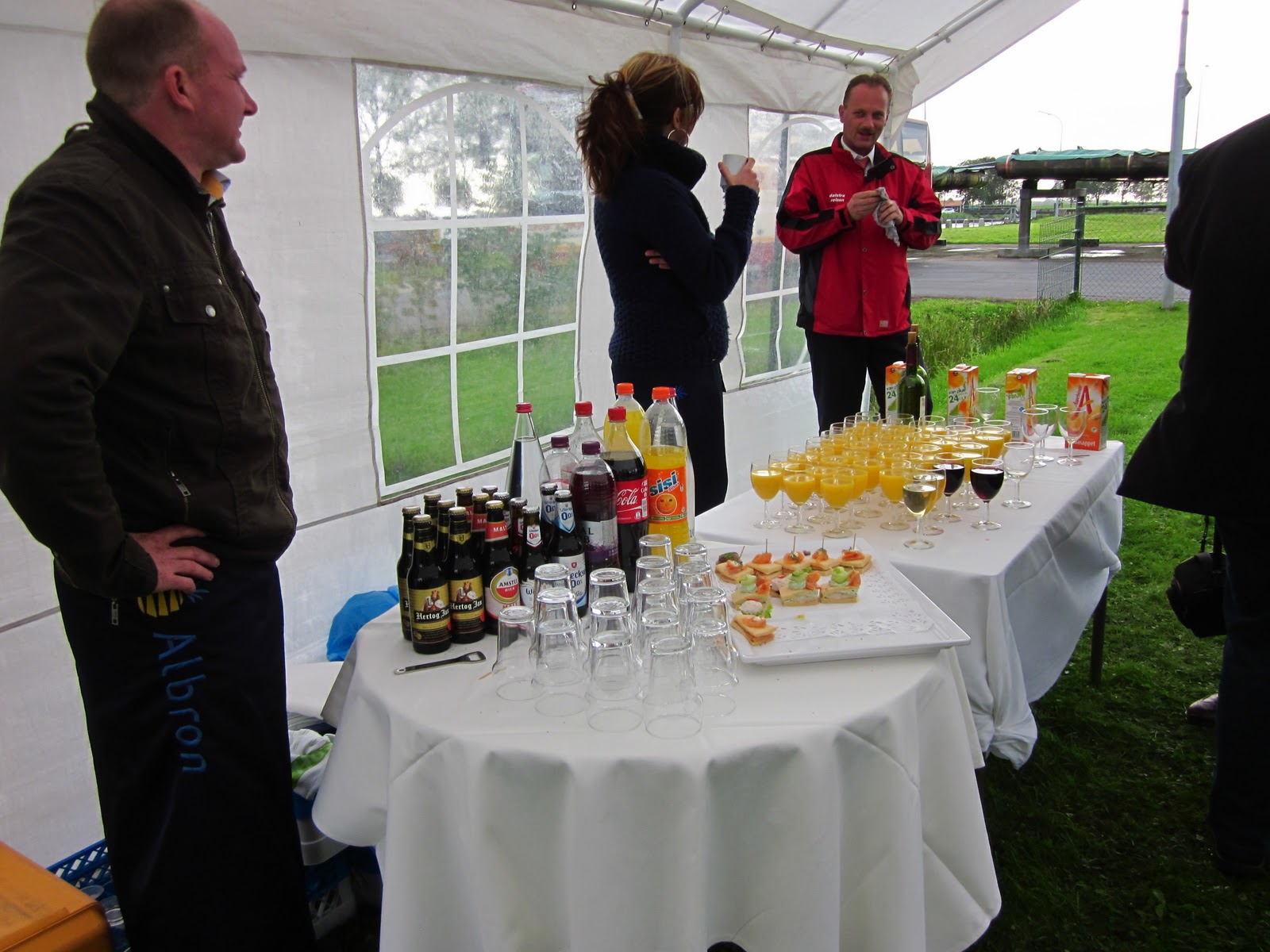
Next to the lock, some refreshments were provided.


On our return to Groningen, we walked to the yellow building, a large tavern-club where we had dinner.

Kathy and Laura looked away from the camera.

Yum!  Chocolate mousse topped with blueberries and chantilly.