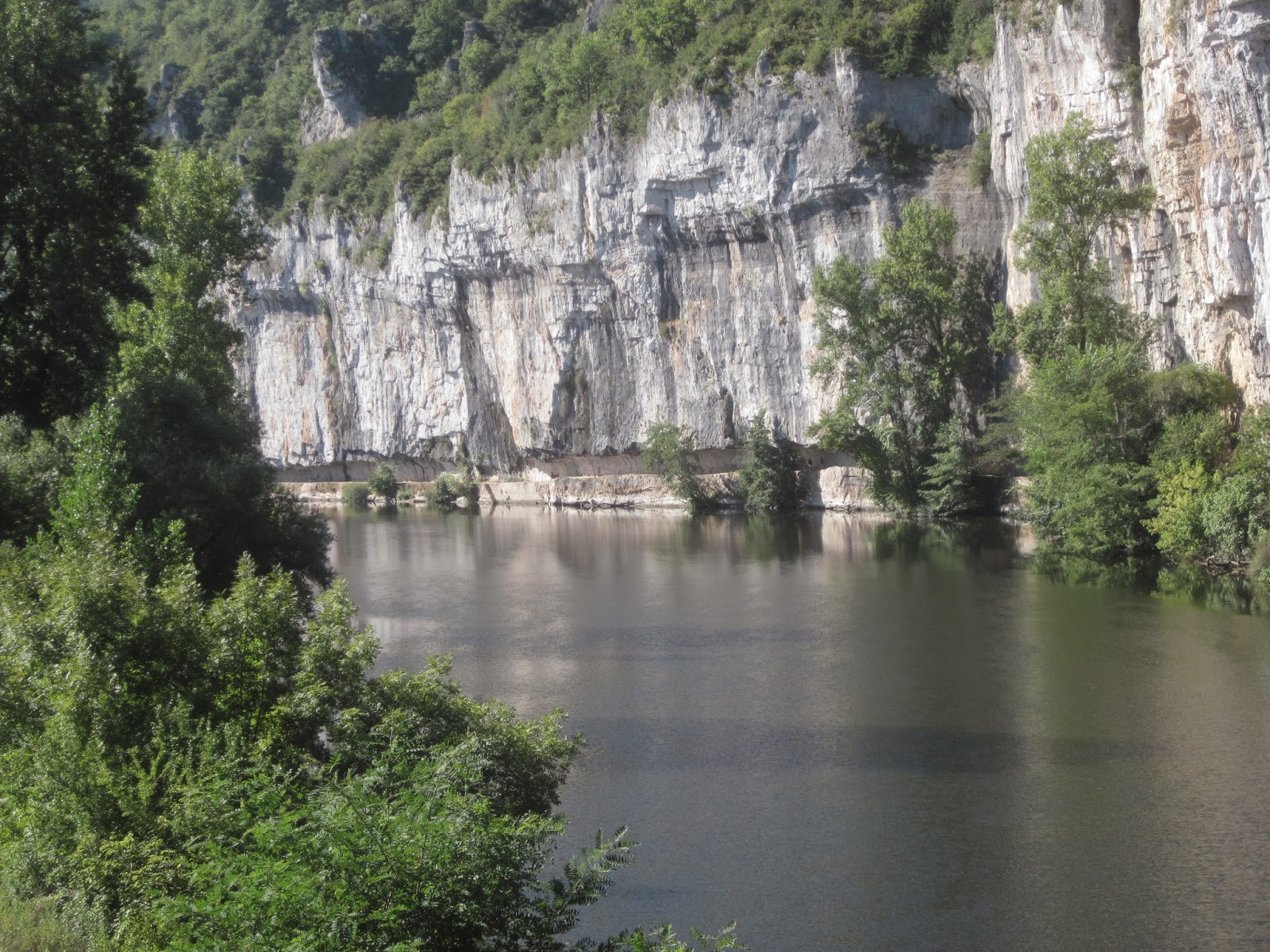
September 23, Monday - - Of course the hotel was comfortable and I awoke refreshed, had a good breakfast, and took a short walk along the river and part of the town of Cahors.
 |
| The new railway bridge at Cahors. |
 |
| And the older bridge - I don't know how old. |
 |
| Cahors is on the Pilgrim Route, and this brass scallop embedded in the sidewalk tells the walkers they're not lost. |
Then we had a rather long ride to the Canal de Lalinde, a 19th century canal that's being rebuilt by local people. It has triple staircase locks near where we stopped for lunch.
 |
| Canal de Lalinde here is right next to a power plant; you can see the great power lines. |
Lunch had been purchased earlier at a
supermarche (supermarket): packaged sandwiches, apples, bananas, and bottled water.
 |
| For some reason (perhaps weary of formal dinners) I just loved this lunch. |
Wonderfully casual for dining
al fresco beneath the trees near the lock. And a short distance away we discovered a roadside fruit/vegetable stand, and gave the proprietress a lot of business.
 |
| Our group quickly bought out her strawberries, some grapes, and a few apples. |
Somewhere before arriving here we passed through a tricky junction of two roads and the canal. DEM said that in 1964 eleven Tour de France riders were killed in a road accident so horrific that the intersection was redesigned. I'll have to research that on the internet.
Having explored the canal and its aqueduct, locks, basin and dry dock, we continued. Our destination was the town of St. Emilion, not for the wineries but for the town itself. St. Emilion has something called a Monolithic Church. At first I thought the guide was referring to medieval Catholicism as being monolithic. Not at all. The church was carved and cut into the limestone rock centuries and centuries ago.
 |
| The gothic windows were built into the rock wall. |
Over time more was built on top of it. We learned more that I can remember; but what I experienced was pretty awesome.
We first went down what the guide called the "least steep" cobbled street to the former town market square.
 |
| On a lovely September afternoon on a crowded street in St. Emilion |
 |
| Steep? yes! Note how we are looking down toward the next footstep. |
The monolithic church formed one side of the square, with added parts mirroring early gothic style (e.g., pointed arch windows). To my dismay (I don't care to be underground) we climbed down narrow stairs to the "hermitage" of St. Emilion to note the well, the stone bed, the fertility chair for women wishing to become mothers. Susan asked if it worked for grandmothers as well. With the affirmative answer, she sat in the chair. We also descended into a very dimly lit catacomb, which I was glad to leave and to enter the monolithic church itself. The hugely tall naves (three of them) were braced up to about 27 feet. This all made me feel a little claustrophobic and was happy to leave there. One has to be very impressed with the devotion and persistance it would take to carve out so much stone. The hermitage and the monolithic church are privately owned and photography was strictly forbidden, a shame, for the structures were massive and impressive.
Then back to the bus for the long ride to Bordeaux and the end of the tour. The Garonne River is tidal at Bordeaux, and very wide and very brown.
 |
| Crossing the Garonne to the west side and Bordeaux. |
It was evening rushhour and impossible to drive the coach to the hotels. We all descended in the midst of traffic (which wasn't going anywhere anyhow),
 |
| David Edwards-May discusses our problem with the coach driver. Clearly we were not going anywhere in a hurry. |
we retrieved our luggage, and began walking along the long pedestrian plaza toward the Best Western Grand Hotel.
 |
| Well, I think everyone managed to quickly retrieve belongings; we would not see that coach again, ever. |
The room was quite nice, with a tub and two shower heads. A quick hop into the shower, change of clothes, and set out to explore before dinner at the brasserie. My friends Barbara and Pat were staying at a different hotel but showed up to go exploring with me. Actually they wanted to show me their hotel, so off we went. Luckily, we could also persuade the concierge to print our boarding passes for our flight to Paris the next day.
Dinner at the Brasserie was fun. We were seated in the wine cellar (really!), around two very large tables. Here are photos of the entire group, many of whom I shall not see again until next year in Milan.
 |
| L-R = Roger, ??, Ian, Agnes |
 |
| L-R = Dennis, Kerry, Barbara |
 |
| L-R = Norman, Jill, ??, Carol |
 |
| L-R = Rod, Pat, Jill, Clive, David |
 |
| L-R = Sylvain, (coach driver), Susan, Rod, Pat, Jill, Clive, David |
 |
| L-R = ??, ??, Sylvain, (coach driver), Susan |
 |
| L-R = Agnes, Vicky, David, Mike, Roseleen |
After this very nice final dinner together, the next part of the trip was leaving. Leaving friends is always leavened by the prospect of being together again next year in Italy.
The return home on Tuesday was lengthy (taxi, flight to CDG, flight to IAD, ride to the house) and the hours went by slowly. An unexpected and wonderful thing at Dulles Airport was that the Arrivals Hall was nearly empty so we whizzed through all of that quickly. And was home with my husband at last.