Showing posts with label Pantheon. Show all posts

Saturday, August 14, 2010

Globus tour, June 11, Ancient Rome

Next after St. Peters:  find the Globus bus - in a huge undergound bus garage full of other buses.  Big jam-up because one other bus decided to stop in a driving lane.  As we drove along the river, I got a glimpse of Garibaldi's statue up on the Janiculum Hill, that is all.  Some other visit.  Cross the Tiber on the Ponte Palatino below an island in the center of the river, drive along the Via del Circo Massimo at the foot of the Palatine Hill, then Via di San Gregorio, off the bus, wait to cross the wide street.  Just before the Colisseum, where we had the group photo taken, Joe finally bought a hat:  white straw with black band.  He was happy.  It reminded him of  Robert Mitchum in the film Cape Fear.

Joe in his new hat, at Arch of Constantine.


Ruins on the Palatine Hill
This visit was busy, crowded and confusing.  Remains of Ancient Rome viewed toward the Capitoline Hill.  We walked around the Arch of Constantine, walked through the Arch of Titus, passed the Temple of the Vestal Virgins (or so Marco said, but which ruin was it), looked over the Forum (or one of them) from the Arch of Septimus Severus (I think), and the back down the way to get in line, and enter the Colisseum all the while beseiged by water sellers, hat sellers, postcard sellers, Roman soldiers (re-enactors, of course).  Is it any wonder I remember little that Marco said?
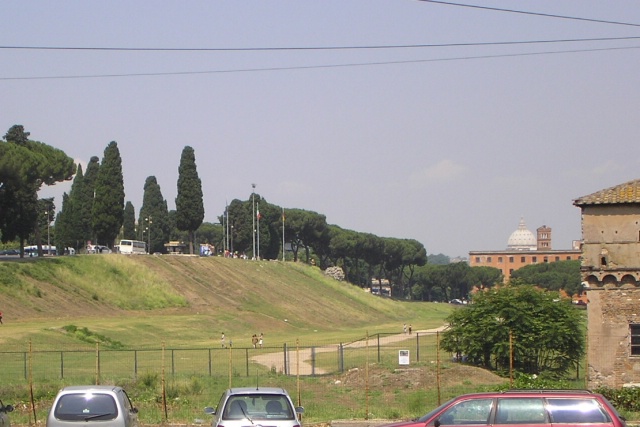
Circus Maximus today
According to Marco, the  Colisseum was the source of building materials for Renaissance popes:  bronze, marble blocks and capitals, and so on.  Fifteenth-century re-cycling?  So that's why the massive structure looks rather unfinished.  As we looked down from the Arch of Titus, the ruins that we had seen were excavated recently (20th century).  Two hundred years ago, it would have looked like the Circus Maximus now looks:  a large grassy field.

So today we saw the Rome of the Renaissance Popes as well as the Rome of antiquity.  Marco emphasized that the Roman empire fell in the fifth century AD, and then invaders wrecked much of it, including the aqueducts.  No aqueducts meant no water for the hills of Rome.  Over time the population fell from one million at the height of empire to about thirty thousand.  A medieval pope built an aqueduct to the Lateran Palace (is that the Palatine hill?) which remained the papal residence for hundreds of  years.   Construction campaigns occurred in the 14th and 15th centuries, and the papal states of the Vatican were strengthened with the support of French kings.  And so the area of the Capitolilne was abandoned.  Also in 330 AD or so,  the emperor Constantine converted to Christianity and so did the Romans; "pagan" ways slowly passed into obscurity, ending the gladiatorial games.

Well that was all for Monday's scheduled tour.  Joe and I opted for the additional excursion to see more.  After a quick lunch and nap, there was time for a visit to a travel agent to arrange our return by train to Paris in 2 weeks in an overnight couchette for 2 on Sunday, June 24.  First, though, we had to agree whether to stay on in Rome an extra day or go immediately back to Paris when the tour ended.

Back on the bus, up the Tiber past Ara Pacis, Piazza del Populo, borghese Gardens to Via Lucovici, the walk back to Trinita Dei Monti (someday I'll need to know all these names) and there below where those famous Spanish Steps.  With hundreds of people all over and below. 

Rachel on the Spanish Steps
Joe quickly left to re-visit the Keats Museum at the foot of the steps, and I got involved with Karen from Canada who was tracing our route on her  map.  For a few moments we lost our tour group - I didn't want that to happen twice in the same day.  At the Keats Museum I climbed up the many stairs to find Joe.  A young girl offered to help me and I told her who I was looked for.  Then I walked into what looked like a library, where I saw Joe just as the girl announced that I couldn't go in.  Joe joined me and we left.  Then I learned that there is an admission fee, and that's why I could not go in.  Oops. 


down the Spanish Steps - Keats Museum is just off camera on the right
The Spanish Steps were so called because the Spanish Embassy is nearby, in a lovely palace whose gate was open and we could see the interior courtyard - a glimpse of sunlight and plants and flowers beyond a colonnaded passageway in dark shadow.  My impression of the Spanish Steps is that it's very very crowded and hot - - but isn't June the height of the tourist season?

The Pantheon's pediment
So onward.  We walked to the Trevi Fountain.  Another huge crowd scene.  Threw the coin over the shoulder to ensure returning to Rome.  Past the Antonine Column to the Piazza Rotonda at the Pantheon, and had a very good vanilla gelato, met the group, and into the Pantheon - which I'd missed the day before because of Sunday Mass.  Marco told a great story about how King Vittorio Emanuele, the very first king of unified Italy, wanted to be entombed there - buried in this building.  But he had been excommunicated, and excommunicants cannot be buried in conecrated ground.  What to do to accommodat this great national hero?  Easy:  deconsecrate the church for one day, put the late kind into his tomb, and then reconsecrate the church.

Here comes the bride.
On to the Piazza Navona (this time in daylight) and the great Four Rivers  Fountain.  A bride drove up to the nearby church of  Sant'Agnese in Agone and excited her big car to bystanders' applause.  One of the bystanders noticed she had some undone buttons on the back of her gown and did them up for the bride.  It's a big beautiful church, with a facade designed by Borromini.  This is where Marco left us.  He was an excellent guide, very very professional and experience.  No question to him went unanswered - often in several paragraphs.

Tuesday, August 3, 2010

June 10 - First morning in Rome

I survived the unnerving first hour in Rome, and eventually relaxed as it became evident that Joe's memory of place was in overdrive.  So our first night in the Eternal City was done, time for my first shower there and first breakfast there . . . Joe was already in the Hotel Pomezia's dining room.  He went out early to retrace in daylight our evening route:  Campo dei Fiore and Corso Vittorio Emanuele, but without crowds or police.  Breakfast was plentiful:  coffee, orange or pineapple juice, corn flakes, three kinds of pastry and bread, butter, cheese, and jam.  Very strong coffee.  I had a quiet time without Joe to write about the the train trip of Saturday and the awful walk to find the hotel last night.  There were many very young American women in the dining room and only one young American man.  I think they are highschoolers; Joe thinks college.  He later learned they are from Savannah College of Art and Design.

Church of S. Ivo alla Sapienza
Check-out from the hotel is 11 am and I went out at 10 to find the Pantheon.  Walked up the Corso Rinascimento, stumbled upon the church of S. Ivo alla Sapienza (?), where a large courtyard passes through a kind of cloister to the small church with the odd spiral dome or steeple.  Mass was in progress.  I went and heard the Pater Noster sung in Italian - the great and wonderful sound of a few voices reverberating in the church brought me to tears.  It is a small baroque church in the form of a Greek cross.  Twelve elaborate silver candleholders behind the altar, a large painting above it.  In front of the altar was a simple vase with a large sheaf of grain - oats?  wheat?  I felt this was a great place to have happened upon.

Continued walking onward.  After considerable confusion I realized that the Church of St. Mary and the Martyrs is also the Pantheon.  I'd walked around it thinking I was right, but was misled by the signs that identified it as the church, and that while Mass was being said all tourists were kept out.  So I missed.  I walked round behind to find Bernini's elephant carrying an obelisk (you have to see it, but here is a photo)
one of the many cats in Largo Argentina
What's the back story?


 and Santa Maria Sopra Minerva Church.  But time ran out.  I got lost, hurried back to Corso Vittorior Emanuele, past the Largo Argentina with all of its ruins and cats [above, right] and the back of the dome of S. Andrea delle Valle, and to the Hotel Pomezia.  Joe was in the lobby, having all of our luggage there too.  He asked the desk clerk to call a taxi to take us to the Cicerone Hotel, and then had to explain that we were to join our tour there.
Entry to the Cicerone Hotel
The Hotel Cicerone is a very large hotel (compared with what we'd seen during the past several days) not far from the Vatican.  The room is typical European size on the first floor (that's the second floor in the USA), street side, twin beds, closet, table, lamp; chairs, long shelf beneath the wall to wall window, a TV, and a nightstand between the beds, all in very soothing shade of green.  We napped a bit, wrote in journal, washed two white shirts, and cleaned up the stained knee from the fall at Genoa's train station.  We reconnoitered the lobby and ground floor to get our bearings.  Per the tour's message board, our guide is named Nicholas (no last name), and all are to meet in the lobby at 5 p.m.