Wednesday, August 18, 2010

Globus tour, June 11 - the end of the day

The last thing I recall about the Piazza Navona is the crowd of beggars at the North end.  Several patheticly handicapped people, like a young woman whose fet and toes turned inward and curled, sitting on a curb, begging withopen hand, and a young man on a sheeled sort of dolly whopushed himself along with one hand inside a black sneeker.  I felt so badly about ignoring them that I will try to give a coin to some others as we progress through Italy.

Dinner was at Togana, on the river, with music from Italian operas, live.  The music exceeded the food.  The tenor was excellent. 
Dinner with an operatic quartet

The mezzo sang the Habanera and flirted with every man in the place.  The soprano was expressionless and at times sharp, and the baritone, who was also the master of ceremonies, was also a very good comic actor.   But my man Joe was by far the star of the show. 
Figaro 'shaving' Joe

"Figaro," the barber of Seville, needed someone to shave and Joe was the lucky man.  I have only two photos, but someone from another group sent him others.

Monday ended with a very long and satisfying sleep.  I'm getting to know our fellow travellers, who are all English-speaking, from the US, Canada, and Australia.

Saturday, August 14, 2010

Globus tour, June 11, Ancient Rome

Next after St. Peters:  find the Globus bus - in a huge undergound bus garage full of other buses.  Big jam-up because one other bus decided to stop in a driving lane.  As we drove along the river, I got a glimpse of Garibaldi's statue up on the Janiculum Hill, that is all.  Some other visit.  Cross the Tiber on the Ponte Palatino below an island in the center of the river, drive along the Via del Circo Massimo at the foot of the Palatine Hill, then Via di San Gregorio, off the bus, wait to cross the wide street.  Just before the Colisseum, where we had the group photo taken, Joe finally bought a hat:  white straw with black band.  He was happy.  It reminded him of  Robert Mitchum in the film Cape Fear.

Joe in his new hat, at Arch of Constantine.


Ruins on the Palatine Hill
This visit was busy, crowded and confusing.  Remains of Ancient Rome viewed toward the Capitoline Hill.  We walked around the Arch of Constantine, walked through the Arch of Titus, passed the Temple of the Vestal Virgins (or so Marco said, but which ruin was it), looked over the Forum (or one of them) from the Arch of Septimus Severus (I think), and the back down the way to get in line, and enter the Colisseum all the while beseiged by water sellers, hat sellers, postcard sellers, Roman soldiers (re-enactors, of course).  Is it any wonder I remember little that Marco said?

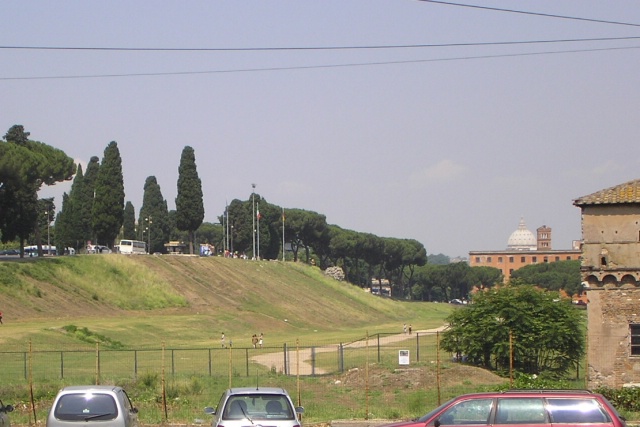
Circus Maximus today
According to Marco, the  Colisseum was the source of building materials for Renaissance popes:  bronze, marble blocks and capitals, and so on.  Fifteenth-century re-cycling?  So that's why the massive structure looks rather unfinished.  As we looked down from the Arch of Titus, the ruins that we had seen were excavated recently (20th century).  Two hundred years ago, it would have looked like the Circus Maximus now looks:  a large grassy field.

So today we saw the Rome of the Renaissance Popes as well as the Rome of antiquity.  Marco emphasized that the Roman empire fell in the fifth century AD, and then invaders wrecked much of it, including the aqueducts.  No aqueducts meant no water for the hills of Rome.  Over time the population fell from one million at the height of empire to about thirty thousand.  A medieval pope built an aqueduct to the Lateran Palace (is that the Palatine hill?) which remained the papal residence for hundreds of  years.   Construction campaigns occurred in the 14th and 15th centuries, and the papal states of the Vatican were strengthened with the support of French kings.  And so the area of the Capitolilne was abandoned.  Also in 330 AD or so,  the emperor Constantine converted to Christianity and so did the Romans; "pagan" ways slowly passed into obscurity, ending the gladiatorial games.

Well that was all for Monday's scheduled tour.  Joe and I opted for the additional excursion to see more.  After a quick lunch and nap, there was time for a visit to a travel agent to arrange our return by train to Paris in 2 weeks in an overnight couchette for 2 on Sunday, June 24.  First, though, we had to agree whether to stay on in Rome an extra day or go immediately back to Paris when the tour ended.

Back on the bus, up the Tiber past Ara Pacis, Piazza del Populo, borghese Gardens to Via Lucovici, the walk back to Trinita Dei Monti (someday I'll need to know all these names) and there below where those famous Spanish Steps.  With hundreds of people all over and below. 

Rachel on the Spanish Steps
Joe quickly left to re-visit the Keats Museum at the foot of the steps, and I got involved with Karen from Canada who was tracing our route on her  map.  For a few moments we lost our tour group - I didn't want that to happen twice in the same day.  At the Keats Museum I climbed up the many stairs to find Joe.  A young girl offered to help me and I told her who I was looked for.  Then I walked into what looked like a library, where I saw Joe just as the girl announced that I couldn't go in.  Joe joined me and we left.  Then I learned that there is an admission fee, and that's why I could not go in.  Oops. 


down the Spanish Steps - Keats Museum is just off camera on the right
The Spanish Steps were so called because the Spanish Embassy is nearby, in a lovely palace whose gate was open and we could see the interior courtyard - a glimpse of sunlight and plants and flowers beyond a colonnaded passageway in dark shadow.  My impression of the Spanish Steps is that it's very very crowded and hot - - but isn't June the height of the tourist season?

The Pantheon's pediment
So onward.  We walked to the Trevi Fountain.  Another huge crowd scene.  Threw the coin over the shoulder to ensure returning to Rome.  Past the Antonine Column to the Piazza Rotonda at the Pantheon, and had a very good vanilla gelato, met the group, and into the Pantheon - which I'd missed the day before because of Sunday Mass.  Marco told a great story about how King Vittorio Emanuele, the very first king of unified Italy, wanted to be entombed there - buried in this building.  But he had been excommunicated, and excommunicants cannot be buried in conecrated ground.  What to do to accommodat this great national hero?  Easy:  deconsecrate the church for one day, put the late kind into his tomb, and then reconsecrate the church.

Here comes the bride.
On to the Piazza Navona (this time in daylight) and the great Four Rivers  Fountain.  A bride drove up to the nearby church of  Sant'Agnese in Agone and excited her big car to bystanders' applause.  One of the bystanders noticed she had some undone buttons on the back of her gown and did them up for the bride.  It's a big beautiful church, with a facade designed by Borromini.  This is where Marco left us.  He was an excellent guide, very very professional and experience.  No question to him went unanswered - often in several paragraphs.

Globus tour, June 11 - the first day with Globus

We were up and doing well before the 6:00 am wake-up call, and among the first at breakfast, a pretty extensive buffet.  And onto the Globus bus at 7:10, meet Marco, our guide for the day, and arrive at the Vatican Museum at 7:40.  There were hundreds of people in the forecourt when the doors opened at 8:00 am - - and these are all tour groups! 

We wait for the Vatican Museum to open, with Marco (holding the flag) our guide
Marco explains and describes the Sistine chapel - no talking in there!!
Entry for individuals is at 10:00 am.  We walked through rooms of tapestries, ancient statues, frescowed maps - many things I'd like to have viewed longer - and into a courtyard for a lengthy explanation and history of Michelangelo's work on the Sistine Chapel.  Other artists painted wall scenes and Michelangelo at age 33 began work on the ceiling, spent four years on the project at the insistance of Pope Julian II.  Michelangelo insisted that he was a sculptor, not a painter, and in the end he returned to sculpting.  When he was later ordered to paint the Last Judgment, his work was criticized by a Cardinal, and for revenge the Cardinal was depicted with donkey ears and a large serpent biting his genitals.  What revenge, to carry down through centuries!

We had only 15-20 minutes in the Sistine chapel.  It was totally crammed with people.  Every few minutes the guards clap their hands loudly, tell everyone to hush, and remind all "No Pictures!" in loud abrupt tones.  Quiet for a moment or two and then gradually the hubbub begins again.  There's nothing I can say about this room.  It is so famous and so renowned that all I can note is what an odd experience it was.

We had entered beneath the donkey-eared devil (Cardinal) of the Last Judgment.  I looked for Botticelli frescoes among those on the side walls.  One that I am sure was his is Christ being presented in the temple.  I found a seat (they are along the sides) for a moment, the better for looking up, and then met the group at the "Stove Door" - the place where as stove is installed during the conclave - it burns the ballots for a new pope.  And on that note, we exited.

Inside St. Peter's, looking at the side.
And down corridors and stairs, and on to a door at the side of the front entry of St Peter's.  Of course, the basilica is simply enormous - beyond imagining - huge, impressive, and very very baroque in its decoration. The guide, Marco, said that Michelangelo designed a renaissance building and would be very angry to see what it became.  It is decidedly all "tarted up", with not a single surface unadorned with some curvy non-classical thing.  So I agree with Marco.  I thought of the Shrine of the Immaculate Conception in Washington, DC; how stunning it was when I was a college student, and it had just been consecrated.  Simple and unadorned but huge, a rather stark space with an enormous red and gold masaic of the risen Christ in the semicircular apse behind the altar.

Studying the tomb of Pope John XXIII, the group moved on without me.  I could hear Marco in the audioguide, but when I turned around, not a familiar face anywhere!  I wandered several minutes before I spied his little Italian flag.

St Peter's Square from the front porch.
And then in to the great St. Peter's Square - which isn't.  It's an elippse or circle or oval, but it's not square.  The piazza was full of chairs being arranged for the Wednesday audience with Benedict XVI.  My overall impression is of enormous patient crowds of people and many many tour groups.  Probably never a day without them.  How many were pilgrims, how many were, like us, tourists.
More chairs

Wednesday, August 11, 2010

June 10 in Rome, continued

We were settled in the Cicerone Hotel.  The time and place had been posted for the first meeting of this tour with Globus.  With several hours to kill, we walked down Via Cicerone toward the big white building that is the Hall of Justice, at Piazza Cavour, and on toward Castel Sant'Angelo on the west bank of the Tiber River.

Approaching Castel Sant'Angelo

Castel Sant'Angelo [7 euro entry fee] began as a great mausoleum built by emperor Hadrian in the 2nd century AD.  A circular building, with a great long ramp rising toward the top, it has a little military museum and a wonderful terrace cafe.  We had lemonade that was incredibly good and refreshing on a hot Italian day.  

Lemonade in the shade

We climbed up a staircase to a large terrace or rampart just below the huge statue of St. Michael sheathing his sword.  The statue tops the structure (well, surrounded by many communication antennae).  From this terrace is a grand panorama of Rome, from St Peter's and the Janiculum Hill on the right, past the Tiber River below, to the vast city out in the distance to the east and north.  Funny how from up there it looks as though Rome has a lot of green space - however not in the central core.  This was a wonderful place to pass a few hours.  And the whole time I never thought of the opera "Tosca" - in the last act after her lover's execution, she leapt to her death over the parapet.

Joe at the Castel Sant'Angelo ramparts with the city behind him.

On the way back to the hotel we stopped for gelato:  dark chocolate for me, very dark and very strong flavor, and lemon (limone) for Joe - very sour but very tasty as well.  And then a bit of a rest before going to the lobby to meet the tour director/guide.  There were lots and lots of folks milling around, from all the other tour companies, including Globus. Our guy is Nicolas; the other Globus guide is a little woman named Annnick - it was she who helped us sort things out when we arrived at the hotel.
Our first meeting with Nicolas the guide

As Nicolas' group had no meeting room at the hotel, we walked a few blocks to a ristorante.  Nicolas spent the first 30 minutes explaining procedures regarding breakfast, baggage, audioguides, and emphasized that the next day would begin very early and would be the most strenuous day in terms of what areas of Rome we would cover.  And then dinner began:  antipasti (coldcuts and mozarella), pasta (2 kinds), veal scallopini with cheese, and asparagus and green beahc, and a kind of cheescake with small berries and currents - very yummy.  Lots of wine flowed, but I limited myself to just a glass and a half.


Nicolas also explained an add-on tour on the following afternoon to the Spanish Steps, the Trevi Fountain, Pantheon, Piazza Navona, and then an "opera/dinner".  We considered it and at first rejected it because of the price, but quickly reconsidered.  A funny side occurance:  Each person had been assigned a number to affix to our suitcases.  As I went to Nicolas to get my number, he also asked "one bed or two" and my initial reaction was "That's none of your business."

On a bridge over the Tiber River.


After dinner, Joe and I walked a bit toward the river and the bridge of angels, and then turned in very early.  A long day, and our tour has barely begun.

Tuesday, August 3, 2010

June 10 - First morning in Rome

I survived the unnerving first hour in Rome, and eventually relaxed as it became evident that Joe's memory of place was in overdrive.  So our first night in the Eternal City was done, time for my first shower there and first breakfast there . . . Joe was already in the Hotel Pomezia's dining room.  He went out early to retrace in daylight our evening route:  Campo dei Fiore and Corso Vittorio Emanuele, but without crowds or police.  Breakfast was plentiful:  coffee, orange or pineapple juice, corn flakes, three kinds of pastry and bread, butter, cheese, and jam.  Very strong coffee.  I had a quiet time without Joe to write about the the train trip of Saturday and the awful walk to find the hotel last night.  There were many very young American women in the dining room and only one young American man.  I think they are highschoolers; Joe thinks college.  He later learned they are from Savannah College of Art and Design.

Church of S. Ivo alla Sapienza
Check-out from the hotel is 11 am and I went out at 10 to find the Pantheon.  Walked up the Corso Rinascimento, stumbled upon the church of S. Ivo alla Sapienza (?), where a large courtyard passes through a kind of cloister to the small church with the odd spiral dome or steeple.  Mass was in progress.  I went and heard the Pater Noster sung in Italian - the great and wonderful sound of a few voices reverberating in the church brought me to tears.  It is a small baroque church in the form of a Greek cross.  Twelve elaborate silver candleholders behind the altar, a large painting above it.  In front of the altar was a simple vase with a large sheaf of grain - oats?  wheat?  I felt this was a great place to have happened upon.

Continued walking onward.  After considerable confusion I realized that the Church of St. Mary and the Martyrs is also the Pantheon.  I'd walked around it thinking I was right, but was misled by the signs that identified it as the church, and that while Mass was being said all tourists were kept out.  So I missed.  I walked round behind to find Bernini's elephant carrying an obelisk (you have to see it, but here is a photo)
one of the many cats in Largo Argentina
What's the back story?


 and Santa Maria Sopra Minerva Church.  But time ran out.  I got lost, hurried back to Corso Vittorior Emanuele, past the Largo Argentina with all of its ruins and cats [above, right] and the back of the dome of S. Andrea delle Valle, and to the Hotel Pomezia.  Joe was in the lobby, having all of our luggage there too.  He asked the desk clerk to call a taxi to take us to the Cicerone Hotel, and then had to explain that we were to join our tour there.
Entry to the Cicerone Hotel
The Hotel Cicerone is a very large hotel (compared with what we'd seen during the past several days) not far from the Vatican.  The room is typical European size on the first floor (that's the second floor in the USA), street side, twin beds, closet, table, lamp; chairs, long shelf beneath the wall to wall window, a TV, and a nightstand between the beds, all in very soothing shade of green.  We napped a bit, wrote in journal, washed two white shirts, and cleaned up the stained knee from the fall at Genoa's train station.  We reconnoitered the lobby and ground floor to get our bearings.  Per the tour's message board, our guide is named Nicholas (no last name), and all are to meet in the lobby at 5 p.m.

Friday, July 30, 2010

June 9th - the late night travels continue

Back to the Campo dei Fiore, where we sat down to a 10:30 supper of gnocchi and white wine.  Very nice waitstaff. 
Can we eat here?  Please?
Many young people wandering all over the place, and a few old people like Joe and me.  Once I had something to eat, I felt finally like a normal person again.  I'd been so patient with Joe after my meltdown in the hotel, while he ran all over the place looking at places he'd last seen in 1964.  But I really really was glad to have been fed at last.


Then we moved on to the Piazza Navona.   The famous fountains were encased in scaffolding, for over the years the stone was stained that odd sulfur-yellow in my pictures, and the stone is being carefully cleaned.  So we could not see much of the beautiful Fountain of the Rivers (Fontana dei Fiumi).


Finally on the Corso Vittorio Emanuele, Joe found the building where Eugene Walter had lived.  Eugene Walter was from Mobile, Alabama, and a "friend of a friend" from Joe's years in that city.  He was a writer, actor, editor.  He had lived in Rome for many many years, was friend and neighbor of Leontine Price there, and was very kind to Joe in 1964.  The building appears now to be all offices, no residences. 

18, Corso Vittorio Emanuele
And that was that.  We made our way pack to the Hotel Pomezia and to sleep in an airconditioned room.


All told, my favorite place from the week in France was Nice.  The hotel was so fine, with doors that opened to the sky and overlooked the park.  The beach of stones sloping down to the multi-hued sea.  The old part of the city, with its flower market by day and cafes by night, the uniformity of its old buildings, pastel, yellow, ochre,  with shutters and balconies, four or five stories tall.  Very narrow streets and lanes.  The wide Marche aux Fleurs that becamse the busy dining area with umbrellas, tables, chairs down the center.  And with the next day we would begin our tour of Italy with some two or three dozen other people


Thursday, July 29, 2010

June 9th from Nice to Rome

The trains in Europe are well organized.  The cars and the seats are numbered both inside and outside.  On the platform a display shows where each care is aligned on the platform:  We went to area W for car numbered 17.  The train was on time.  It had little compartments on the land side, not on the sea side.  This train to Italy runs along the Riviera and is a good ride because of the scenery:  the sea on the right, hills and mountains on the left.
Steep Riviera hillside
Occasionally tunnels cut the route through peninsulas. The area is densely populated along most of the way. Two Russians chatted with us on the way from Nice to their daytrip destination, San Remo.


The approach to the Genoa station where we were to change trains goes through a very extensive port area - not very pretty but certainly different from the earlier scenery.  We had a two-hour layover in Genova . . . after I fell when I left the first train.  A station attendant and two woman rushed to make sure I was okay.  And I was, other than having dirt on my trousers and embarrassment on my face.  The waiting room was air-conditioned, a good thing because Genoa was very hot.  The station entry has Roman temple features:  columns, pediment, white stone.
Facade of Genoa's train station.

Inside we talked with an information agent (with difficulty because of our language deficiencies) about Nice-Genoa-Rome vs. Nice-Milan-Rome.  He explained that Milan is farther to the northeast than Genoa, but it does have a TGV to Rome.  But that entire trip is longer than the one we chose.
The Genoa-to-Rome train passes through a very large stone-cutting area.  We passed many stoneyards with huge rectangular blocks, and some that were cut into thin slices (perhaps for the facing of buildings, or stairsteps, or piazzas and patios?)  There was white stone, red-pink stone, black-dark grey stone.
We also passed many hayfields that were recently cut and full of hay rolls, like the ones we see in Virginia but smaller.  I didn't see pastureland with cows or sheep or horses  . . . well, one or two farms with horses.  But they looked to be riding horses.  Neither did I see mules or donkeys.  And no sign of a hog-pen.

Two Candians joined our cabin from Pisa to Rome and told us scary tales of how dirty Rome is, full of graffiti, and gave us warnings about thieves, pickpockets, and gypsies, especially near the train station, called, appropriately, Termini.

So we were apprehensive on exiting the train, and being after 8:00 pm, night was coming on soon.  Joe insisted that he knew what he was doing from his 1964 visit.  It was very odd:  all of the exits from this enormous station were closed except for one.  The huge crowd had to slowly funnel through it.  I was nervous the whole time, and wanted to stop and get my bearings.  Joe wanted to plow forward to avoid the rumored pickpockets and gypsies.  He prevailed.  We shuffled toward and then through the one exit.  There were cops everywhere (polizia and carabinieri).  The reason:  President Bush had been in Rome for the day and there had been a huge anti-Bush demonstration (what French and Italians both call a "manifestation").  But why did the cops want to scan the people who were leaving the Termini?  We'd all been somewhere else. 

Note the police buses on the left side of the plaza.
Outside the station is a huge area for buses and taxis, but it was completely empty.  Not allowed.  Joe set off walking straight away from the station.  We soon flagged a taxi and learned that the Corso Vittorio Emanuele was closed, blocked off because of the demonstrations.  We rode as far as the large monument to Victor Emmanuel, thanked and paid the driver, took some photos of the cops standing around, and hauled my rolling suitcase over the very bumpy cobblestone streets, got lost, went here and there and, it seemed, everywhere.  Finally between my figuring out the map and Joe getting direction from a passerby, we arrived at the Hotel Pomezia.  And I had a large meltdown, crying that I hate Rome, I hate the dark streets and the crowds and the hotel without air conditioning.  But Joe saved the night - - he asked the desk clerk and learned how to se the air condition.  My hero!

Hotel Campo Dei Fiore
So it's a little late to be wandering out in the scary city full of thieves, pickpockets, and gypsies, maybe 9 pm --  But there were plenty of police, and so we went out to find the Campo dei Fiore.  Joe was so happy to find the Hotel of that name where he'd stayed 43 years before.  However, it had been sold and the new owner had renovated it, and so it looked a little different. 
Still, we went up to the roof terrace for a great view over the evening sky of Rome and all of its domes and church towers.  It was a great view, but soon my old nasty fear of heights came on, so I had leave. 

On to the Piazza Farnese, and we found Camponeschi Ristorante.  That was for Joe Camponeschi who works in my office - - some far distant cousins own it.  It's a very nice looking, classy place, not a cafe or bistro or tavola calda. I talked with an elderly, well-dressed, well-groomed man, the maitre-d' or owner, I don't know.  When he found out I had no reservation, he wordlessly turned and slowly walked away.  Still I took a photo of the entrance for my colleague. 

This large piazza is very lovely.  Two large basins that catch the waters of the fountains were taken from the Caracalla Baths.  They do resemble giant bathtubs.  The Palazzo Farnese is now the French embassy.  It's a graceful three-story Renaissance building along one of the long sides of the piazza, painted yellow, with a heavy cornice.  And in the corner between the Palazzo and the Camponeschi were parked three buses marked "Polizia", being loaded up with cops who were obviously happy to go off duty.
Palazzo Farnese, now the French Embassy