Tuesday, August 24, 2010

Globus tour, June 14 - more of Venice

This man just turned red-hot glass into a blue vase!
[My blog's days are mixed up.  June 12, Breaking Away, is out of order and I don't know how to fix it.] 
June 14:  No luggage out today!  Globus bus to boat to the island of Murano for a tour of a glass-blowing factory.  We settled into some bleachers in the workroom (evidently this demonstration is a common practice), and watched an old man who has worked there since he was 11 years old.  He turned a red-hot blob into a vase that was cobalt blule, with a fluted huge lip, and long slim neck, and a bulbous base. 

Another man took a small amount of molten glass, also red-hot, and created a little horse that was aqua-colored inside and clear crystal outside.  Both of them were older men, but beyond them were younger men working individually.  So this strange craft does not seem in danger of dying.

This was followed, of course, by a visit to the sales room.  This large room was full of glass shelves with a multitude of brilliantly colored decanters, vases, pitchers, coffee services. 
Sales pitch in the glass-blowing factory
Multi-colored glass
The shelves were backed by mirrors, and large chandeliers hung over the table that ran down the center of the room.  Very pretty and colorful.  Some people bought sets with decanters or coffee service, for shipment home.   We have little or  no space for such in our small house, and we do not entertain on a grand scale.  I looked at the individual art pieces and then at the jewelry room   I could not resist a small bracelet made of glass and gold beads.  But I can only take so much of overpriced frou-frous.  So I went outside for a little walk along a canal.

Nicolas directed me down the quai, across a little canal on a sweet bridge, and into San Donato Church to see the mosaics.  The church seems to be notable for the mosaic stone floor - -
mosaic floor
covered in very geometric patterns in many-colored triangles, squares, rectangles, with a few that depicted something more material - - like a rooster.  It was lovely to be in this quiet and empty church, by myself for a few moments.  I just needed to stretch my legs, but also to rest my mind.

Ceiling of a staircase.
Back on the boat toward Piazza San Marco, where we met the local guide, Loradona.  She guided us through the Doge's Palace.  This palace is full of staircases of great magnificence, many rooms with wonderful paintings on the walls and ceilings by Veronese and Tintoretto, no place to sit, huge number of other tours all with "whisper" devices round their necks.  It was a little overwhelming.  And from the Great Hall of the Doge, we then headed down a tiny narrow low-ceiling stair to the claustrophobic passage leading across the Bridge of Sighs.   This is the place where prisoners were led from the court where they were sentenced to the prison from which, if they were very fortunate, they might someday return. We walked through that prison, a horrible place with narrow corridors, huge bars and heavy small wooden doors to the cells.  I did not like it at all.   One fellow, Fred, I think, was so overcome that he pushed through ahead of all of us to escape.  Finally, we crossed back over the Bridge to the Doge's Palace, down a very lovely spacious staircase, and exited.  This put us in a small courtyard next to the Basilica of San Marco, next stop on the tour.
A courtyard next to the Basilica

Once inside the Basilica, I found again beautiful floors of small colored stones in geometric patterns, like those I'd seen before on Murano.  The building is centuries old and its floor so worn by centuries of footsteps that the floor is no longer level but sort of wavy and uneven.  Loradona was very happy to see that the lights were on; on for thirty minutes and off for thirty minutes, I believe she said.  With illumination we could see the gold-highlighted mosaics that cover the ceilings, the domes and the walls.  However, no stopping at all, ropes to keep us in the aisles, just go, go, go.  To be rushed through a magnificent church of the size and fame of San Marco, with entry restricted only to thosse who pay an admission fee, was disappointing in the extreme.  Not at all like France, where entry to churches is not restricted.

An afternoon at leisure in  Venice.  So off we went, Joe and I, to find the Dalmatian Scuola, officially called the Scuola San Giorgio degli Schivoni.  This took a long time, with many wrong turns, especially one that was less than 100 feet from the building.   We finally got it right, waited a bit for the 2:45 pm re-opening (after lunch).  A woman with keys opened four locks; two were antique with great large keys; two more were modern.  Inside the walls had paintings that each told a story.  St. George battled his dragon.  Next painting, he led the dragon into town on a bridle.Then my favorite:  St. Jerome who had tamed a lion by removing a painful thorn from the lion's paw.  The painting depicted the saint leading his lion into town and all the monks in their blue and white robes were fleeing in terror, climbing trees and stairs to escape the beast.  
St. Jerome and the lion, painted by Carpaccio
A wonderful painting - a bit like a modern-day graphic novel in one frame.   I think we spent maybe a half an hour looking at and talking about them all.

Before we found the Scuola, we passed a Chinese restaurant.  It smelled good.  It was half-full with Asian diners.  It was not expensive.  We were hungry.  So we had  soup and eggrolls and spicy cabbage in the heart of Venice.  And they had lemon soda and ice to pour the soda over.

At some point I left Joe and went looking for the little park I'd seen from the lagoon, with trees, shrubs, benches.   It was full of young teens taking up most of the red benches.  Italian teens act much like those at home:  travel in groups,  mostly boys with boys, girls with girls; and with cellphones everywhere. 
There are no benches along the quai.
The entire quai along this part of the  Grand  Canal is crowded with kiosks that sell all sorts of souvenirs:  teeshirts, hats, Carnival masks, keychains, mugs, beaded bracelets and earrings and necklaces, umbrellas of lace, umbrellas with images of Venice.  And lots of people, young, not-so-young, and old.  It reminded me of the Midway at a county fair, but without the yelling and noise.  What would it be like in November, without all the summer visitors?

At the boat dock we were to meet Nicolas beneath the green clock.  It was a funny sight.  Everyone was there, but they were all crammed down a narrow, shady, breezy passageway.  The wide quay was too exposed, very hot, very crowded.  While some had bought glass back on Murano, the older West Virginia daughter was proud of her negotiation with an African streetvendor for purchase of a purse.  Bev from Australia had a white teeshirt that spelled "Venezia" in rhinestones.  I had bought amber glass earrings from one of the kiosks.

Another boat ride back to the bus, then a bus ride back to the hotel.  If I ever visit Venice again, I'm staying in Venice.  Too much travel time otherwise.  After dinner, Joe and I took a short walk through the neighborhood.  We washed some shirts and hoped they'be be dry by morning when the luggage was put out for another motor trip.

Sunday, August 22, 2010

Globus tour, June 12 - breaking away

The River Arno, from the Ponte Vecchio.
Joe and I walked away from the group rather than spend time in a gold merchant's shop.  At the Ponte Vecchio we walked across slowly, paused at the little mid-bridge plaza for some photos. 


It was awfully hot and awfully crowded.  Across the river we found a little cafe in the shade, sat down, and had a most refreshing iced tea with lemon, for 4 euro.  While we were doing that, most of the others followed Nicolas into a large goldseller's store.  Absolutely the last thing I wanted to do.

We'd determined the meeting place before our escape:  the Piazza San Croce.  The church of San Croche is another lovely white and green marble building, which we just looked at, didn't go into.

As we sat in the shade of an enormous fountain, a woman sitting behind Joe asked if he'd had a good shave today.   She and her companion had been in the restaurant last night - different tour group - and they recognized Joe.  We engaged in conversation and were joined by a number of others who knew an Asian man who may have videoed Joe's operative debut in the barber's chair.  We made sure to leave Joe's email address before we rejoined Nicolas and our group back on the Globus bus again to our home for the night.

On the Via Lorenzo il Magnifico was our hotel of the same name, a palazzo converted to modern hotel.  At first I was apprehensive about our room being on the top floor with no other rooms there.  We had to take the elevator with a special key for our floor.  But it was a spacious, magnificent room with windows on three sides.  Once I figured out how to open the outside shutters, we had a marvellous breeze.  In the hotel's garden is a large magnolia tree; its top was just beyond one of our windows.  I was delighted, and very tired.  I lay down for a quick nap.  Very nice.


The hotel's bar was like an elegant drawing room with twenty-foot ceiling that was coffered and carved wood.  Several large chairs and sofas upholstered in pale striped fabric, and french doors leading out to a small terrace and the garden.  A small bar area in one corner had some hors d'oeuvres set out.  No one approached them until the older noisy woman decided that it was all for us.  Well, she was very wrong.  Nicolas entered the room laughing.  He told us the food was for bar guests only and that the hotel manager was upset with us for gobbling it up. 

Dinner this night was in a small family-run place a few doors from the hotel.  Its name is Il Cavaliere, and a sandpiper-like bird was painted next to the name.


  This was a very pleasant dinner, with time for conversation without lots of distraction, and Joe engaged in conversation with the six-person family all night long.  I mainly saw his back.  But I chatted with Bev and Trish, who are from Australia.  This restaurant had the best pork I've ever eaten - large juicy chop, really delicious.   The two women and I split a bottle of prosecco that was quite good and not so very dry.  Dessert was creme caramel.  I think Joe was remembering how he got sick in Paris at Christmas, so he just tasted his.

Although the room was so beautiful, it didn't put me to sleep.  I had a restless night - perhaps some sort of odd exhaustion kept me from sleeping well.

Friday, August 20, 2010

Globus tour June 13 - From Florence to Venice via Pisa

I think I'd always known that there would be days spent mainly on the bus.  This was the first.  We drove west from Florence to Pisa, which, in addition to the cathedral, the baptistry, and the tower,
is chock-full of schlocky tourist shops.  We duly photographed each other holding up the Leaning Tower,


and  Joe lingered over an old motorized bicycle that fascinated him.  Then another drive eastward past Florence toward Venice. 

Actually, toward Mestre - which is on the mainland.  We did not stay in Venice.  The hotel in Mestre is fairly large and its lobby needs some refreshing - it is shopworn.  However, the pool area is very very nice.  We got sort of unpacked (two nights here - yea!) and we definitely refreshed outselves in the pool, then cleaned up and rested, and pretty soon it was time to get back on the Globus bus.  Joe and I had signed up for a special dinner boat cruise on the lagoon.  The bus ride to the boat dock was long, not because of distance but because of heavy traffic.
Once on the boat we all had a very welcome glass of prosecco - different from what I'd had the night before.  Another tour group shared the boat with us.  They were boisterous and happy and full of prosecco.  Sunset on Venice's lagoon is something I am glad I experienced. 


I'd never seen sunset from a boat before, and so far had not seen an Italian sunset at all - perhaps because they are hard to see from the middle of a city. 

Dinner:  the appetizer was a seafood salad; next course was canellonni with salmon, followed by salmon steak and some veggies.  Dessert was a washed-out tiramisu.  Food on this tour has not been exceptional [large understatement] other than the pork dinner last night.  Tonight only the seafood salad is worth mentioning.  The table, however, was lovely, and our companions were fun.

The sole musician on board the boat began to play dance music.  Pretty soon the West Virginia grandparents got up to dance. It was very apparent that they were enjoying themselves and that they like swing dancing.  They put on a good show. 

Someone started a conga line that snaked through the lower deck where we were dining and headed for the narrow corridor that led to the narrow stairs up to the open deck.  No room to turn the line and double back.  What will they do?  Everyone just reversed so that the tail became the head and the line reappeared from the narrow corridor.


We docked near the Piazza San Marco and walked the short distance there.  The evening was very wet with rather large puddles in the pavement, an orchestra was playing in an arcade, little cafe tables and chairs out in the rain were empty. 


Rain was sprinkling, kiosk vendors hastily closing up and trying to push through the tourists, but the tourists were all trying to cluster on the tiny areas of dry, un-puddled pavement.  I was fascinated to realize that the sea was bubbling up from the drains in the piazza because of both high tide and a strong wind that blew off the lagoon toward San Marco.  And the Piazza San Marco would soon be all shallow water.  A unique and nice experience really, because night had come on and the rain was very light and the crowd was sparse.   The entire scene was very unusual.  I fear I may never see the like again.

Wednesday, August 18, 2010

Globus tour, June 12 - - On the road again

Luggage call at 7 am, hearty breakfast, on the bus by 8 am.  Joe has developed a dislike for a certain woman.  She is loud, always doing her own thing, is usually late, and sort of sucks the oxygen out of a room.   She travels with her husband (who has bad knees and a sweet attitude) and her grandson (just about college age, and not always very patient with gran).

Nicolas took advantage of the three-hour ride to Florence to explain optional excursions; we signed up for so many that I lost track.  Probably about 8.  Nicolas is very persuasive, good-natured, compassionate, but forceful.  I figure it will cost $900 to $1000 for the extras.
Liborio loads the bus.

David - - in the parking lot
Our  Globus driver is Liborio.  He drove so fast toward Florence that we arrived about half hour early, so we drove up a hill called Piazalle Michangelino.  It gives a good view over the city, dominated by the "Duomo" - - the cathedral, named Santa Maria del Fiore but always referred to as simply "the Duomo".  At the same time, up on that hill, a stage was being erected for "Total Recall Live" and hundreds of young teens, mostly girls, were waiting.  There were also tourist souvenir stands and a very big parking lot that surrounded - get this - a large bronze reproduction of Michelangelo's "David".


Then into the city to a little park called Piazza San Marco, very near the Academia.  But first:  lunch.  I lost Joe but found a good lunch of bruschetta with tomato and mozarella.  Outside the Academia in a goodly long line down a narrow street next to a fellow selling prints.  He lay them down on the street; if anyone dared step on a print, he whipped out his big eraser and cleaned off the marks.  Once again we had the Whisper audioguides, but the sound here was never very good.  We thought turning down the volune would help but it did not.  Likely it was the pitch of the guide's voice that was wrong, or so one of us surmised.  Inside the building the static was so bad, I took off the earpiece.

We wait with our Whisper audio guides.

There were several sculptures in the room that preceded Michaelangelo's David:  his unfinished Prisoners - five or six marble pieces originally intended for the tomb of Pope Julian II.  Why were they unfinished?  Why were they not at his tomb?  Finally, at the end of a short hall, big old David with his finely muscled naked body, his great huge hands, curly hair, big veins in his right hand - the one that holds the stone.  The Academia has a lot of religious art by painters unknown to me;  It also has a really lovely exhibit of Renaissance musucal instruments, like harpsichord, ivory recorder, and stradifarius violin, carved or painted string instruments (violas, lutes, a 10-string guitar - 5 double strings).  No photos allowed, though.

When we left the building it was obvious someone was missing, but the guide didn't want to make a fuss.  It was the vague Aussie man and his wife.  The local guide phoned Nicolas, who showed up to take the situation in hand and to locate the missing persons.  And so we continued walking toward the Duomo.

White and green and pink marble . . .

Big big surprise to me:  The Duomo is not a black and white building.  It is green and pink and white stone!!  Really lovely up close.  I walked round to see as much as I could, which is difficult because the place around it is not wide open and the Baptistry stands right in front.  Lots of folks took photos in front of the "fake" Ghiberti doors. 


Walking past many lovely shops selling many lovely things; tour guide talking all the while; not understanding a word.  We reached the Piazza del Signoria, the "town hall" here being called Palazzo Vecchio.  The piazza is a huge place where Savanarola burned the books, and where he later was himself burned at the stake.  There's a circular marker in the pavement in front of the Palazzo "commemorating" the event. 

Palazzo Vecchio


Lorenzo di Medici
A large-than-life equestrian statue of Lorenzo di Medici stands near one corner of the Palazzo.

Next door is the famous Uffizzi Gallery.  I never got inside because one must have a reservation, apparently months in advance of one's visit.  I had to be content with walking along the famous and graceful loggia to the river bank.  The Arno River's "lungo" is lined with street vendors selling toys, scarves, bracelets, etc, and with cars that whiz along the narrow roadway.  And Joe and I escaped - - stay tuned..


Globus tour, June 11 - the end of the day

The last thing I recall about the Piazza Navona is the crowd of beggars at the North end.  Several patheticly handicapped people, like a young woman whose fet and toes turned inward and curled, sitting on a curb, begging withopen hand, and a young man on a sheeled sort of dolly whopushed himself along with one hand inside a black sneeker.  I felt so badly about ignoring them that I will try to give a coin to some others as we progress through Italy.

Dinner was at Togana, on the river, with music from Italian operas, live.  The music exceeded the food.  The tenor was excellent. 
Dinner with an operatic quartet

The mezzo sang the Habanera and flirted with every man in the place.  The soprano was expressionless and at times sharp, and the baritone, who was also the master of ceremonies, was also a very good comic actor.   But my man Joe was by far the star of the show. 
Figaro 'shaving' Joe

"Figaro," the barber of Seville, needed someone to shave and Joe was the lucky man.  I have only two photos, but someone from another group sent him others.

Monday ended with a very long and satisfying sleep.  I'm getting to know our fellow travellers, who are all English-speaking, from the US, Canada, and Australia.

Saturday, August 14, 2010

Globus tour, June 11, Ancient Rome

Next after St. Peters:  find the Globus bus - in a huge undergound bus garage full of other buses.  Big jam-up because one other bus decided to stop in a driving lane.  As we drove along the river, I got a glimpse of Garibaldi's statue up on the Janiculum Hill, that is all.  Some other visit.  Cross the Tiber on the Ponte Palatino below an island in the center of the river, drive along the Via del Circo Massimo at the foot of the Palatine Hill, then Via di San Gregorio, off the bus, wait to cross the wide street.  Just before the Colisseum, where we had the group photo taken, Joe finally bought a hat:  white straw with black band.  He was happy.  It reminded him of  Robert Mitchum in the film Cape Fear.

Joe in his new hat, at Arch of Constantine.


Ruins on the Palatine Hill
This visit was busy, crowded and confusing.  Remains of Ancient Rome viewed toward the Capitoline Hill.  We walked around the Arch of Constantine, walked through the Arch of Titus, passed the Temple of the Vestal Virgins (or so Marco said, but which ruin was it), looked over the Forum (or one of them) from the Arch of Septimus Severus (I think), and the back down the way to get in line, and enter the Colisseum all the while beseiged by water sellers, hat sellers, postcard sellers, Roman soldiers (re-enactors, of course).  Is it any wonder I remember little that Marco said?

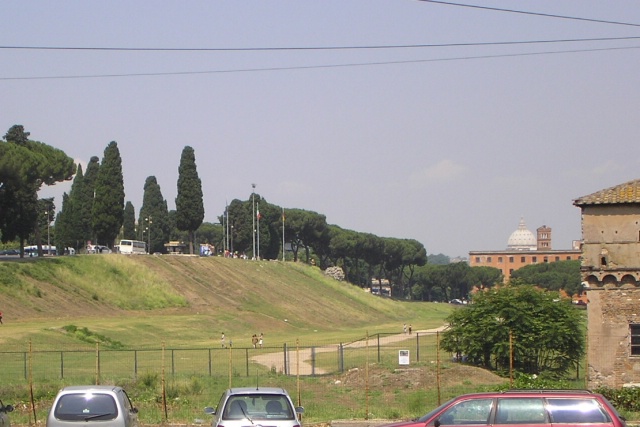
Circus Maximus today
According to Marco, the  Colisseum was the source of building materials for Renaissance popes:  bronze, marble blocks and capitals, and so on.  Fifteenth-century re-cycling?  So that's why the massive structure looks rather unfinished.  As we looked down from the Arch of Titus, the ruins that we had seen were excavated recently (20th century).  Two hundred years ago, it would have looked like the Circus Maximus now looks:  a large grassy field.

So today we saw the Rome of the Renaissance Popes as well as the Rome of antiquity.  Marco emphasized that the Roman empire fell in the fifth century AD, and then invaders wrecked much of it, including the aqueducts.  No aqueducts meant no water for the hills of Rome.  Over time the population fell from one million at the height of empire to about thirty thousand.  A medieval pope built an aqueduct to the Lateran Palace (is that the Palatine hill?) which remained the papal residence for hundreds of  years.   Construction campaigns occurred in the 14th and 15th centuries, and the papal states of the Vatican were strengthened with the support of French kings.  And so the area of the Capitolilne was abandoned.  Also in 330 AD or so,  the emperor Constantine converted to Christianity and so did the Romans; "pagan" ways slowly passed into obscurity, ending the gladiatorial games.

Well that was all for Monday's scheduled tour.  Joe and I opted for the additional excursion to see more.  After a quick lunch and nap, there was time for a visit to a travel agent to arrange our return by train to Paris in 2 weeks in an overnight couchette for 2 on Sunday, June 24.  First, though, we had to agree whether to stay on in Rome an extra day or go immediately back to Paris when the tour ended.

Back on the bus, up the Tiber past Ara Pacis, Piazza del Populo, borghese Gardens to Via Lucovici, the walk back to Trinita Dei Monti (someday I'll need to know all these names) and there below where those famous Spanish Steps.  With hundreds of people all over and below. 

Rachel on the Spanish Steps
Joe quickly left to re-visit the Keats Museum at the foot of the steps, and I got involved with Karen from Canada who was tracing our route on her  map.  For a few moments we lost our tour group - I didn't want that to happen twice in the same day.  At the Keats Museum I climbed up the many stairs to find Joe.  A young girl offered to help me and I told her who I was looked for.  Then I walked into what looked like a library, where I saw Joe just as the girl announced that I couldn't go in.  Joe joined me and we left.  Then I learned that there is an admission fee, and that's why I could not go in.  Oops. 


down the Spanish Steps - Keats Museum is just off camera on the right
The Spanish Steps were so called because the Spanish Embassy is nearby, in a lovely palace whose gate was open and we could see the interior courtyard - a glimpse of sunlight and plants and flowers beyond a colonnaded passageway in dark shadow.  My impression of the Spanish Steps is that it's very very crowded and hot - - but isn't June the height of the tourist season?

The Pantheon's pediment
So onward.  We walked to the Trevi Fountain.  Another huge crowd scene.  Threw the coin over the shoulder to ensure returning to Rome.  Past the Antonine Column to the Piazza Rotonda at the Pantheon, and had a very good vanilla gelato, met the group, and into the Pantheon - which I'd missed the day before because of Sunday Mass.  Marco told a great story about how King Vittorio Emanuele, the very first king of unified Italy, wanted to be entombed there - buried in this building.  But he had been excommunicated, and excommunicants cannot be buried in conecrated ground.  What to do to accommodat this great national hero?  Easy:  deconsecrate the church for one day, put the late kind into his tomb, and then reconsecrate the church.

Here comes the bride.
On to the Piazza Navona (this time in daylight) and the great Four Rivers  Fountain.  A bride drove up to the nearby church of  Sant'Agnese in Agone and excited her big car to bystanders' applause.  One of the bystanders noticed she had some undone buttons on the back of her gown and did them up for the bride.  It's a big beautiful church, with a facade designed by Borromini.  This is where Marco left us.  He was an excellent guide, very very professional and experience.  No question to him went unanswered - often in several paragraphs.

Globus tour, June 11 - the first day with Globus

We were up and doing well before the 6:00 am wake-up call, and among the first at breakfast, a pretty extensive buffet.  And onto the Globus bus at 7:10, meet Marco, our guide for the day, and arrive at the Vatican Museum at 7:40.  There were hundreds of people in the forecourt when the doors opened at 8:00 am - - and these are all tour groups! 

We wait for the Vatican Museum to open, with Marco (holding the flag) our guide
Marco explains and describes the Sistine chapel - no talking in there!!
Entry for individuals is at 10:00 am.  We walked through rooms of tapestries, ancient statues, frescowed maps - many things I'd like to have viewed longer - and into a courtyard for a lengthy explanation and history of Michelangelo's work on the Sistine Chapel.  Other artists painted wall scenes and Michelangelo at age 33 began work on the ceiling, spent four years on the project at the insistance of Pope Julian II.  Michelangelo insisted that he was a sculptor, not a painter, and in the end he returned to sculpting.  When he was later ordered to paint the Last Judgment, his work was criticized by a Cardinal, and for revenge the Cardinal was depicted with donkey ears and a large serpent biting his genitals.  What revenge, to carry down through centuries!

We had only 15-20 minutes in the Sistine chapel.  It was totally crammed with people.  Every few minutes the guards clap their hands loudly, tell everyone to hush, and remind all "No Pictures!" in loud abrupt tones.  Quiet for a moment or two and then gradually the hubbub begins again.  There's nothing I can say about this room.  It is so famous and so renowned that all I can note is what an odd experience it was.

We had entered beneath the donkey-eared devil (Cardinal) of the Last Judgment.  I looked for Botticelli frescoes among those on the side walls.  One that I am sure was his is Christ being presented in the temple.  I found a seat (they are along the sides) for a moment, the better for looking up, and then met the group at the "Stove Door" - the place where as stove is installed during the conclave - it burns the ballots for a new pope.  And on that note, we exited.

Inside St. Peter's, looking at the side.
And down corridors and stairs, and on to a door at the side of the front entry of St Peter's.  Of course, the basilica is simply enormous - beyond imagining - huge, impressive, and very very baroque in its decoration. The guide, Marco, said that Michelangelo designed a renaissance building and would be very angry to see what it became.  It is decidedly all "tarted up", with not a single surface unadorned with some curvy non-classical thing.  So I agree with Marco.  I thought of the Shrine of the Immaculate Conception in Washington, DC; how stunning it was when I was a college student, and it had just been consecrated.  Simple and unadorned but huge, a rather stark space with an enormous red and gold masaic of the risen Christ in the semicircular apse behind the altar.

Studying the tomb of Pope John XXIII, the group moved on without me.  I could hear Marco in the audioguide, but when I turned around, not a familiar face anywhere!  I wandered several minutes before I spied his little Italian flag.

St Peter's Square from the front porch.
And then in to the great St. Peter's Square - which isn't.  It's an elippse or circle or oval, but it's not square.  The piazza was full of chairs being arranged for the Wednesday audience with Benedict XVI.  My overall impression is of enormous patient crowds of people and many many tour groups.  Probably never a day without them.  How many were pilgrims, how many were, like us, tourists.
More chairs